Summary
Biography
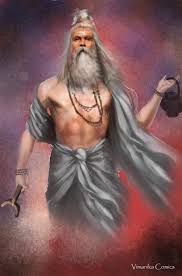
Sage Vishwamitra is one of the most celebrated sages in Hindu tradition, renowned for his immense spiritual journey from a warrior king to a Brahmarishi (the highest level of a sage). His story is one of perseverance, determination, and intense spiritual discipline, and it holds significant philosophical and spiritual teachings. Vishwamitra is credited with composing the Gayatri Mantra, one of the most powerful and revered mantras in Hinduism. His path to spiritual enlightenment, including his struggles with gods and other sages, makes him a unique figure in Hindu mythology.
Early Life and Kingship:
Vishwamitra was originally born as a Kshatriya king named Kaushika, the son of King Gadhi. He ruled the kingdom of Kanyakubja and was a powerful and mighty monarch. His life took a dramatic turn when he encountered Sage Vashishta, another of the Saptarishi, who was known for his profound wisdom and spiritual power.
According to the Ramayana, the story that sets Vishwamitra on his path to becoming a sage revolves around his encounter with Sage Vashishta. When Vishwamitra’s army was defeated by the sage’s divine powers, he felt humiliated and vowed to attain the same level of spiritual power as Vashishta. His desire to gain the status of a Brahmarishi, a title that Vashishta held, became the driving force of his life. This desire led him to renounce his kingdom and embrace the life of a sage.
The Path of Penance and Spiritual Austerity:
To achieve the title of Brahmarishi, Vishwamitra underwent intense penance (tapasya) and austerities. His penance was rigorous and prolonged, often undertaken in the harshest of conditions. Vishwamitra meditated under difficult circumstances, facing numerous trials and temptations. His determination and spiritual discipline earned him the title of Rishi, but he faced several obstacles along the way.
In his quest for spiritual enlightenment, Vishwamitra encountered numerous challenges, including resistance from the gods themselves. His battles with the gods, most notably with Lord Indra, are significant parts of his spiritual journey. Indra, fearing Vishwamitra’s growing spiritual powers, tried to disrupt his penance by sending temptations in the form of beautiful women like Menaka and Ramba. However, Vishwamitra resisted these distractions, illustrating his unwavering commitment to his spiritual goals.
After many years of penance and devotion, Vishwamitra was ultimately granted the title of Brahmarishi by the gods, a status he had fought for and earned through his perseverance. His story exemplifies the idea that through determination and spiritual rigor, one can achieve the highest levels of wisdom and enlightenment, regardless of one’s birth or previous identity.
Vishwamitra and the Gayatri Mantra:
Vishwamitra is best known for composing the Gayatri Mantra, one of the most sacred and powerful mantras in Hinduism. The mantra, found in the Rigveda, is dedicated to the divine light of the cosmos and is considered to have profound spiritual significance. It is said that Vishwamitra was inspired to compose this mantra during his intense meditations, and it was a gift from the divine for his devotion and spiritual power.
The Gayatri Mantra is a prayer to the Sun God, asking for guidance and illumination of the mind. It is composed in the form of a Sanskrit verse, and its chanting is believed to bring spiritual purity, wisdom, and protection from negative influences. The mantra is:
“Om Bhur Bhuvah Svaha,
Tat Savitur Varenyam,
Bhargo Devasya Dhimahi,
Dhiyo Yo Nah Prachodayat”
This mantra is revered by millions of Hindus around the world and is often recited during daily prayers or in moments of deep spiritual reflection. It is said that chanting the Gayatri Mantra with devotion can lead to the awakening of higher consciousness and liberation from worldly desires.
Vishwamitra's Struggles and Battles with Other Gods:
One of the most defining aspects of Vishwamitra’s journey was his intense rivalry with the gods, particularly Lord Indra. As Vishwamitra’s spiritual powers grew, Indra grew anxious about Vishwamitra’s potential to surpass the gods. Indra attempted several times to sabotage Vishwamitra’s penance, using both divine and earthly temptations.
However, Vishwamitra's strength and resolve were unparalleled, and he successfully overcame the challenges placed before him. His story is not just about a quest for power, but a profound exploration of the human spirit’s potential to transcend earthly limitations. Vishwamitra's battles were symbolic of the spiritual struggle between the ego and the higher self, where the gods represented the established order, and Vishwamitra represented the transformative power of relentless devotion.
Vishwamitra and Lord Rama:
Vishwamitra’s journey intersects with that of Lord Rama, the hero of the Ramayana, who becomes one of his most important disciples. In the Ramayana, Vishwamitra takes Rama and his brother Lakshmana to his hermitage, where he trains them in the use of divine weapons and imparts essential wisdom about dharma (righteousness) and life.
Vishwamitra’s role in the Ramayana is crucial, as he not only helps Rama in his early years but also plays a key part in Rama’s victory over the demons and his eventual conquest of evil. Vishwamitra’s guidance to Rama symbolizes the importance of wisdom, spiritual strength, and dharma in overcoming life's challenges.
Vishwamitra's Legacy:
Sage Vishwamitra’s legacy is vast and enduring. He is celebrated as a Brahmarishi, a title that marks the pinnacle of spiritual attainment. His story serves as an inspiration for all seekers on the path of spiritual growth, showing that anyone, regardless of their origins, can attain the highest wisdom through dedication, penance, and devotion.
Vishwamitra's creation of the Gayatri Mantra is one of the most enduring aspects of his legacy, as the mantra continues to be a source of spiritual empowerment for millions of Hindus worldwide. His battles with the gods are symbolic of the spiritual journey, where inner struggles are met with divine grace and guidance.
Vishwamitra’s life teaches that true wisdom and spiritual greatness are not determined by one’s birth or status but by one’s actions, penance, and unwavering commitment to spiritual growth. Through his determination and ultimate success, Vishwamitra remains an eternal symbol of the power of human potential and the path to spiritual liberation.
Conclusion:
Sage Vishwamitra is one of the most fascinating and revered figures in Hindu mythology. From a mighty king to a Brahmarishi, his life embodies the transformative power of devotion, penance, and spiritual perseverance. His composition of the Gayatri Mantra is one of his greatest contributions to Hinduism, and his role as a teacher and guide to Lord Rama further cements his place in the spiritual and mythological landscape of India. Vishwamitra’s story continues to inspire spiritual seekers to this day, showing that with dedication and purity of purpose, one can achieve the highest levels of wisdom and transcendence.