Summary
Biography
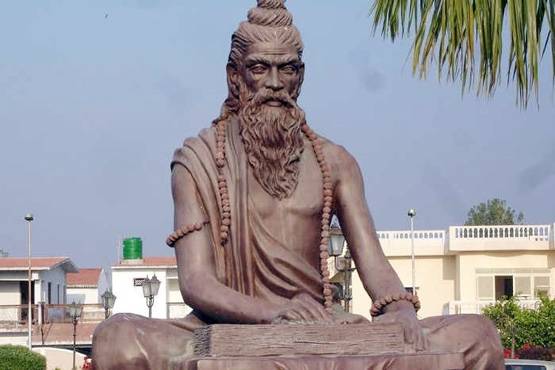
Sage Patanjali is one of the most influential figures in the history of Hindu philosophy, primarily known for his contributions to the development of yoga and Sanskrit grammar. His works, especially the Yoga Sutras, continue to be the cornerstone of classical yoga and spiritual practice, offering a comprehensive framework for meditation, self-discipline, and the path to liberation (moksha). Patanjali’s teachings have not only shaped the spiritual landscape of ancient India but have also left a lasting legacy on the world’s understanding of yoga.
Birth and Lineage:
The exact historical details of Sage Patanjali’s life remain unclear, and there are various legends surrounding his birth. Traditionally, Patanjali is believed to have been born as an incarnation of Ananta, the serpent associated with Vishnu, though other accounts suggest that he may have been born to Sage Gonardiya or to Sage Agastya. Some texts state that he was born as a divine being, while others suggest he was a human sage who attained great spiritual realization.
The name Patanjali itself has several interpretations. One common story suggests that he was named Patanjali because, as an infant, he fell from the heavens (patan) into the hands of a sage (jali). Despite the ambiguity surrounding his birth, what remains undisputed is his monumental contributions to both yoga and Sanskrit grammar.
Patanjali’s Work on Yoga Sutras:
Sage Patanjali is best known for his Yoga Sutras, a concise and profound text that serves as a guide to understanding the theory and practice of yoga. The Yoga Sutras of Patanjali is a compilation of 196 aphorisms (sutras) that outline the philosophy, ethics, and practices of yoga. These sutras are the foundational scripture for classical yoga and have shaped the development of modern yoga practices.
The Yoga Sutras are divided into four chapters:
- Samadhi Pada – The first chapter discusses Samadhi (the state of meditative absorption), the various stages of meditation, and the ultimate goal of yoga: kaivalya (liberation or isolation of the soul from the material world). It outlines the path to attain self-realization through concentration and meditation.
- Sadhana Pada – The second chapter outlines the practical steps one must take to cultivate the right mindset and habits for meditation and spiritual growth. This includes the famous eight-limbed path (Ashtanga Yoga), which forms the core of Patanjali’s teachings.
- Vibhuti Pada – This chapter describes the various powers (siddhis) and mental states that can arise through advanced meditation practices. While these powers are considered distractions on the path to liberation, they highlight the profound transformative potential of yoga.
- Kaivalya Pada – The final chapter deals with liberation (moksha) and the nature of the soul. It discusses how yoga leads to the ultimate freedom from the bondage of the material world and helps the practitioner experience the true nature of the self.
The Eight Limbs of Yoga (Ashtanga Yoga):
One of the most influential aspects of Patanjali’s Yoga Sutras is the eight-limbed path (Ashtanga Yoga), which serves as a guide for spiritual practice and ethical living. These eight limbs are:
- Yama – Ethical restraints or moral disciplines, such as non-violence, truthfulness, and non-attachment to possessions.
- Niyama – Personal observances and self-discipline, including cleanliness, contentment, and self-study.
- Asana – Physical postures or practices that prepare the body for meditation and promote health and flexibility.
- Pranayama – Control of the breath to harmonize the body and mind and to cultivate spiritual energy.
- Pratyahara – Withdrawal of the senses from external stimuli, turning the attention inward.
- Dharana – Concentration or the ability to focus the mind on a single point of meditation.
- Dhyana – Meditation or uninterrupted flow of concentration leading to deep mental absorption.
- Samadhi – The final goal of yoga, where the practitioner experiences unity with the divine and attains liberation.
Patanjali’s Ashtanga Yoga is designed to purify the body and mind, helping the practitioner overcome distractions, attachments, and suffering, ultimately leading to self-realization.
Patanjali’s Contribution to Sanskrit Grammar:
In addition to his philosophical and spiritual teachings, Sage Patanjali is also credited with significant contributions to Sanskrit grammar. His work, the Mahabhashya, is a commentary on Panini’s grammar, the Ashtadhyayi, which laid the foundation for formal grammar in the Sanskrit language. Patanjali’s Mahabhashya is considered one of the most important texts in the history of Sanskrit grammar, clarifying Panini’s rules and making them more accessible.
The Mahabhashya not only discusses grammar but also touches on philosophy, logic, and linguistics. It is one of the primary sources for understanding the evolution of classical Sanskrit and remains a key text for scholars of ancient Indian literature and language.
Patanjali’s Philosophical Contributions:
The philosophy in the Yoga Sutras is rooted in the Samkhya school of thought, especially its dualism of Purusha (consciousness) and Prakriti (nature or material world). While Samkhya offers a theoretical framework for the cosmos, Patanjali’s Yoga Sutras provide a practical method for transcending the limitations of Prakriti and realizing the true nature of Purusha.
Patanjali’s teachings emphasize detachment (Vairagya), mindfulness, and discipline as central components of the spiritual path. His system focuses on calming the fluctuations of the mind (chitta vritti) through meditation, ethical living, and mental training. By purifying the mind and body, a yogi is able to experience kaivalya, the ultimate state of isolation and liberation from the cycle of birth and death.
Influence and Legacy:
Sage Patanjali’s influence on yoga, philosophy, and spirituality is immense and enduring. His Yoga Sutras have shaped the practice of yoga for millennia, with both traditional and modern yogis adhering to the principles he outlined. His teachings have influenced various yoga schools, including Hatha Yoga, Raja Yoga, and Kundalini Yoga.
Patanjali’s work has not only impacted Hindu philosophy but has also had a lasting influence on Buddhism and Jainism, which incorporate elements of yoga and meditation in their spiritual practices. In the modern era, his Yoga Sutras are studied worldwide by spiritual seekers, philosophers, and practitioners of yoga.
Conclusion:
Sage Patanjali is one of the most influential figures in the history of Indian philosophy and spirituality. As the author of the Yoga Sutras, he provided the world with a comprehensive system for mental and spiritual growth, emphasizing meditation, self-discipline, and ethical conduct. His contributions to Sanskrit grammar further demonstrate his intellectual breadth. Patanjali’s teachings continue to be a beacon for those seeking to understand the nature of the mind, body, and soul, and they remain integral to modern yoga practices worldwide.