Summary
Biography
Sage Narada is one of the most celebrated and intriguing figures in Hindu mythology, known for his extraordinary role as a divine sage, messenger, and spiritual guide. His name is synonymous with wisdom, music, and devotion. Narada’s unique ability to bridge the realms of gods, sages, and humans makes him a central figure in many Hindu texts, particularly in the Bhagavata Purana and other Puranic scriptures. He is often depicted as a wandering sage who travels freely between the worlds, spreading knowledge, devotion, and spiritual teachings.
Birth and Origin:
Narada’s origins are described in various ways in different texts, and his birth is often shrouded in divine mystery. In some versions, he is said to be the son of the sage Brahma or a celestial being. In the Bhagavata Purana, Narada is said to have been born to a maidservant in a divine household. His mother was a servant of the gods, and Narada’s story highlights his transformation from a humble beginning to a great spiritual figure.
In other accounts, Narada is described as a Manasaputra of Brahma (mind-born son), which implies that he was created by the divine mind and has a spiritual nature from birth. Regardless of his exact origin, Narada’s extraordinary qualities are undeniable: he is portrayed as a being who is deeply devoted to the divine, has vast spiritual knowledge, and plays a crucial role in the cosmic order.
Role as a Divine Messenger:
One of Narada’s most prominent roles in Hindu mythology is as a messenger between the gods and humans. He is often depicted as traveling across the three realms—heaven, earth, and the underworld—carrying divine messages, conveying the will of the gods, and sometimes playing the role of a catalyst for significant events.
Narada is particularly close to Lord Vishnu and is considered his devoted follower. In many stories, he is depicted as an ardent devotee of Vishnu, often singing his praises and spreading the teachings of Bhakti (devotion). He acts as a messenger and intermediary, helping to guide humans and gods in their respective journeys and missions.
Narada’s divine role as a messenger is often linked to his ability to influence the course of events, sometimes playing the part of an instigator, teacher, or peacemaker. For example, he is credited with provoking key actions in epic stories, such as setting the stage for the Kurukshetra War in the Mahabharata, or instructing devotees like Prahlada and Dhruva in the path of devotion.
Narada’s Instrument – The Veena:
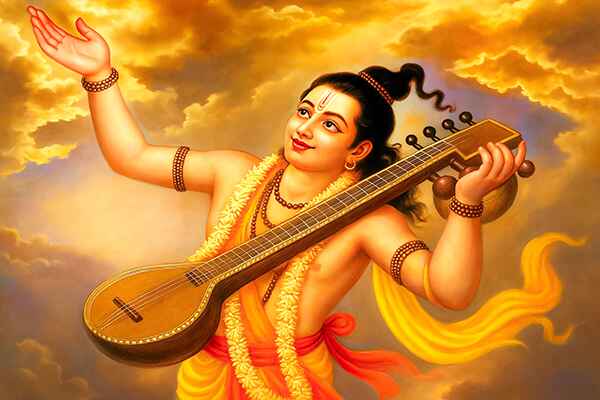
Another unique and beloved characteristic of Sage Narada is his mastery of music, particularly his skill with the Veena, a traditional Indian string instrument. Narada is often depicted carrying a Veena, symbolizing his deep connection to the arts and spirituality. His music is said to be divine in nature, with the ability to inspire devotion and transcendental consciousness.
In many stories, Narada uses his music to induce states of ecstasy and devotion among gods and humans alike. His songs, which are often hymns dedicated to Vishnu, are said to help invoke the divine presence and elevate the consciousness of those who hear them. The Veena and Narada’s musical prowess are emblematic of the harmonious relationship between the spiritual and material worlds, where art, music, and devotion serve as a medium for connecting with the divine.
Narada in the Bhagavata Purana:
The Bhagavata Purana holds Narada in high regard, describing him as one of the greatest devotees and spiritual teachers of the time. In the Bhagavata Purana, Narada is often portrayed as an influential sage who plays a pivotal role in the lives of other key characters, such as Prahlada, Dhruva, and Vyasadeva.
Narada’s story in the Bhagavata Purana emphasizes his role as a wanderer who spreads divine knowledge and encourages individuals to cultivate devotion (bhakti) to Lord Vishnu. He is often portrayed as an initiator of significant spiritual transformations, guiding his devotees to practice selfless devotion and transcend their egoistic desires.
In one of the most famous episodes in the Bhagavata Purana, Narada is said to have advised Prahlada, the son of the demon king Hiranyakashipu, to practice devotion to Vishnu. Prahlada’s unwavering devotion despite his father’s opposition is a powerful narrative that underscores Narada’s influence as a guide and teacher in the path of Bhakti.
Narada’s Role in the Mahabharata:
Narada also appears in the Mahabharata, where he plays a role in shaping the fate of key characters. One of his significant contributions in the epic is his role in facilitating the wisdom of Bhishma, Yudhishthira, and other characters. Narada’s counsel in the Mahabharata often serves to guide the protagonists in the pursuit of righteousness and dharma, especially during critical moments in the war.
In the Mahabharata, Narada is known to have been instrumental in the dissemination of spiritual knowledge, including helping to define the relationships between various characters, such as those between Draupadi and Kunti, and the importance of maintaining divine favor in the battlefield.
Narada and the Concept of Bhakti:
Narada is a prominent figure in the propagation of Bhakti, the path of devotion, which is a central tenet of many Hindu traditions. His unwavering devotion to Vishnu and his constant practice of spreading devotional love are seen as exemplars of the Bhakti movement.
Narada’s teachings, particularly those conveyed through the stories in the Bhagavata Purana, emphasize that anyone, regardless of their background or status, can attain liberation through heartfelt devotion to God. His life and stories stress that the supreme goal of human existence is to surrender oneself in devotion to the divine, transcending all material desires and attachments.
Narada's Philosophical Wisdom:
As a philosopher and sage, Narada’s wisdom extends far beyond mere religious devotion. He is known for his insightful teachings on the nature of the self, the universe, and the eternal soul (Atman). Narada’s dialogues with various gods and sages provide deep philosophical insights, particularly in relation to the concept of Brahman (the Supreme Being) and the Atman (the self).
Narada is also recognized for his role in promoting the practice of dhyana (meditation), and his influence on the development of yoga practices, especially those focused on devotion and inner contemplation. His role as a spiritual guide is not limited to just one group of people; he is portrayed as a universal teacher, guiding all beings towards the realization of the divine.
Narada’s Legacy:
Sage Narada’s legacy is vast and multifaceted. He is not only a revered figure in the Puranas but also an important character in the epics of Hinduism, embodying the virtues of devotion, wisdom, and service. His teachings on bhakti continue to inspire millions of followers around the world to embrace the path of devotion and surrender to the divine.
His musical talents, profound wisdom, and role as a messenger between the gods and humans ensure that Narada remains an iconic figure in Hindu tradition. He is remembered as a sage who transcended boundaries, moving between realms to spread the light of knowledge and devotion, bringing people closer to the divine.
Conclusion:
Sage Narada is a central figure in Hindu mythology, revered for his spiritual wisdom, devotion to Vishnu, and his role as a divine messenger. His influence on the spread of Bhakti and his philosophical teachings on the nature of the self and the universe make him one of the most important sages in Hindu tradition. Whether depicted with his Veena or delivering messages to the gods, Narada’s life serves as a beacon of devotion, knowledge, and selfless service to the divine. His legacy as a spiritual guide continues to inspire devotion and enlightenment for those seeking to understand the deeper truths of existence.