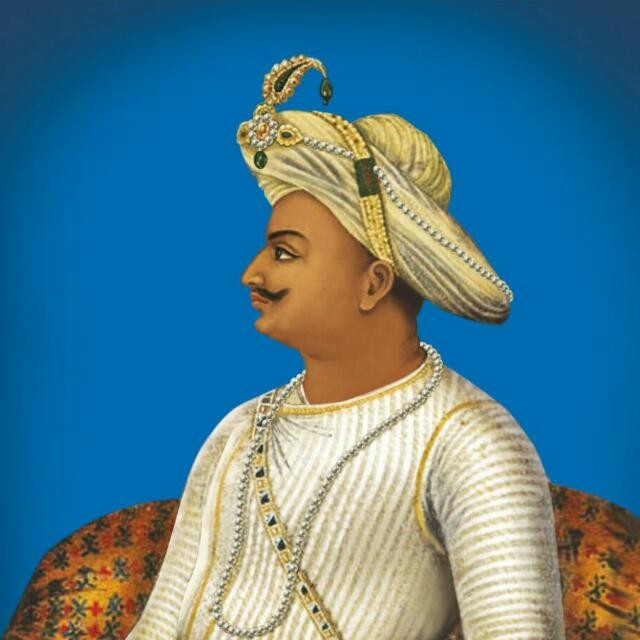
Personal Information
- Date of Birth: 20 Nov 1751
- Place of Birth: Devanahalli Fort, Bangalore, Karnataka, India
- Date of Death: 04 May 1799
- Place of Death: Srirangapatna, Mysore, Karnataka, India
- Nationality: Indian
- Occupation: King, Military Commander, Strategist, Statesman, Administrator, Warrior
- Era: 18th Century, Pre-British Colonial Resistance, Mysore Kingdom Era
Summary
Biography
Tipu Sultan, born on 20 November 1751 at Devanahalli Fort near Bangalore, India, is one of the most iconic figures in Indian history. Known as the “Tiger of Mysore,” he was a revolutionary leader, military strategist, and administrator who fiercely resisted British expansion in southern India. His innovative military tactics, administrative reforms, and dedication to his people established him as a symbol of courage and nationalism.
Early Life and Education
Tipu Sultan was the eldest son of Hyder Ali, the de facto ruler of Mysore, and Fakhr-un-Nissa, a Persian noblewoman. From a young age, Tipu received extensive training in military strategy, martial arts, administration, and languages. He learned Arabic, Persian, and Kannada, and was deeply educated in Islamic jurisprudence, history, and statecraft.
Growing up in a politically turbulent era, Tipu Sultan observed the struggles of his father against the British East India Company, Marathas, and Nizam of Hyderabad. This early exposure to military campaigns and governance profoundly shaped his worldview and leadership style.
Ascension to Power
Tipu Sultan began his military career under the guidance of his father, Hyder Ali. He participated in numerous campaigns during the First and Second Anglo-Mysore Wars, gaining experience and recognition as a fearless commander. When Hyder Ali died in 1782, Tipu Sultan ascended the throne of Mysore and inherited a kingdom facing threats from multiple sides, including the British.
Tipu Sultan was determined to continue his father’s legacy and preserve Mysore’s sovereignty. He immediately strengthened the military, modernized administration, and expanded alliances with regional powers and the French to counter British influence.
Military Innovations and Strategies
Tipu Sultan is celebrated for his innovative military strategies. He introduced advanced rockets and artillery into warfare, which were later studied and adopted by European armies. His use of mobile cavalry, fortified positions, and guerrilla tactics made Mysore a formidable opponent for the British.
He also emphasized intelligence gathering and espionage, ensuring that Mysore’s forces had timely information about enemy movements. Tipu’s leadership in battle inspired fear among adversaries and loyalty among his soldiers.
Resistance Against the British
Tipu Sultan’s reign is most remembered for his resistance against the British East India Company during the Third and Fourth Anglo-Mysore Wars. He fought multiple battles, including the Battle of Pollilur (1780), where he achieved a decisive victory against the British, and the siege of Srirangapatna.
Despite facing a technologically advanced and well-resourced British army, Tipu Sultan utilized his knowledge of the terrain, advanced weaponry, and disciplined forces to mount a strong resistance. His aim was not only to protect Mysore but also to challenge British colonial expansion in India.
Administrative Reforms
Apart from his military achievements, Tipu Sultan was an able administrator and visionary ruler. He reformed revenue collection, encouraged trade and commerce, promoted agriculture, and modernized Mysore’s bureaucracy. He also established a network of factories for arms and cannon production, making Mysore self-sufficient in military technology.
Tipu Sultan promoted religious tolerance and included diverse communities in his administration. He invested in infrastructure, including roads, canals, and irrigation projects, which improved the economic condition of his kingdom.
Alliances and Diplomacy
Tipu Sultan sought alliances with the French, Marathas, and other regional powers to strengthen Mysore against the British. His diplomatic skills allowed him to maintain Mysore’s independence for years despite constant military pressure. Tipu’s foreign policy was focused on creating a united front against colonial expansion.
Death and Legacy
Tipu Sultan died on 4 May 1799 defending Srirangapatna during the Fourth Anglo-Mysore War. His death marked the end of organized Mysorean resistance against the British, but his legacy lived on as a symbol of courage, innovation, and patriotism.
Tipu Sultan is remembered as a pioneer of modern military technology, a visionary ruler, and a nationalist leader who fought to protect his people and sovereignty. His life continues to inspire historians, students, and freedom fighters alike.
Historical Significance
Tipu Sultan’s historical significance lies in his multifaceted role as a military genius, nationalist ruler, and reformer. He demonstrated that organized resistance, technological innovation, and strategic alliances could challenge colonial powers. Tipu Sultan’s legacy influenced subsequent generations of Indian leaders in their struggle for independence.
Cultural Impact
Tipu Sultan’s cultural impact is immense. In Karnataka and southern India, he is celebrated through monuments, literature, folk songs, and museums. His bravery and vision have made him a central figure in India’s narrative of resistance against colonialism. Tipu Sultan’s innovations in rocketry influenced European warfare, and his administrative reforms laid the foundation for efficient governance in Mysore.
Conclusion
Tipu Sultan (1751–1799), the Tiger of Mysore, remains one of India’s most celebrated freedom fighters and visionary rulers. He defended Mysore against the British East India Company, pioneered military innovations, and implemented progressive administrative reforms. His courage, strategic brilliance, and nationalism make him an enduring symbol of resistance and leadership in Indian history.
