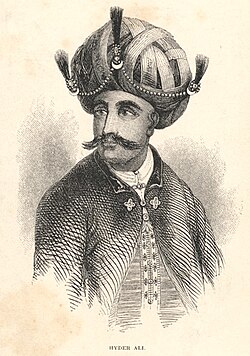
Personal Information
- Place of Birth: 1720, Budikote, Kolar district, Karnataka, India
- Date of Death: 07 Dec 1782
- Place of Death: Srirangapatna, Mysore, Karnataka, India
- Nationality: Indian
- Occupation: King, Military Commander, Strategist, Statesman, Warrior, Ruler of Mysore
- Era: 18th Century, Pre-British Colonial Resistance, Mysore Kingdom Era
Summary
Biography
Hyder Ali, born in 1720 in Budikote, Kolar district of Karnataka, India, was a formidable ruler and military commander whose leadership transformed the Kingdom of Mysore into a major power in southern India. Known as the father of Tipu Sultan, Hyder Ali’s strategic vision, administrative reforms, and military genius left an indelible mark on Indian history. His life is a testament to courage, foresight, and resistance against colonial ambitions in the 18th century.
Early Life and Rise to Power
Hyder Ali was born into a modest family; his father, Fath Muhammad, was a military officer under the Kingdom of Mysore. From an early age, Hyder Ali demonstrated intelligence, bravery, and a keen interest in military affairs. He started his career as a soldier in the Mysore army and quickly rose through the ranks due to his strategic abilities, discipline, and charisma.
During the reign of Krishnaraja Wodeyar II, Hyder Ali earned recognition for his leadership and tactical skills in various campaigns. By the mid-18th century, he had become the Faujdar (commander-in-chief) of Mysore, gaining both military and political influence.
Military Genius and Strategies
Hyder Ali is widely regarded as one of India’s earliest military innovators. He modernized the Mysore army by introducing European-style artillery, disciplined infantry, and effective cavalry units. He also emphasized training in guerrilla tactics, which proved highly effective against the British East India Company and rival Indian states.
His campaigns against the Marathas, the Nizam of Hyderabad, and the British demonstrated his strategic brilliance. Hyder Ali successfully expanded Mysore’s territories while maintaining internal stability. He relied on speed, surprise attacks, and detailed intelligence networks to outmaneuver larger forces.
Conflict with the British East India Company
Hyder Ali’s name is inseparably linked with resistance against the British East India Company. He led Mysore in the First and Second Anglo-Mysore Wars, defending his kingdom against superior British forces. His military campaigns were marked by skillful use of terrain, disciplined troops, and innovative strategies.
In 1767, Hyder Ali first confronted the British in the First Anglo-Mysore War. Despite facing well-equipped European armies, he managed to hold his ground and expand Mysore’s influence. His understanding of both conventional and unconventional warfare made him a formidable opponent.
Hyder Ali’s conflicts with the British were not merely military; they also involved diplomacy. He formed alliances with the French, Marathas, and other regional powers to strengthen Mysore’s position. These alliances allowed him to challenge British expansion effectively and maintain Mysore’s sovereignty.
Administration and Governance
Beyond his military achievements, Hyder Ali was an able administrator. He introduced reforms to improve revenue collection, strengthen trade, and modernize Mysore’s economy. He invested in infrastructure, encouraged agriculture, and promoted industries such as silk weaving, which became a hallmark of Mysore’s prosperity.
Hyder Ali maintained law and order while ensuring that his subjects’ welfare was a priority. His governance combined military discipline with pragmatic civil administration, which strengthened Mysore internally while preparing it to resist external threats.
Family and Succession
Hyder Ali married several times and had multiple children, the most notable being Tipu Sultan, who inherited his father’s vision and continued the struggle against British expansion. Hyder Ali’s emphasis on military training and education ensured that Tipu Sultan was well-prepared to lead Mysore and resist colonial forces after his death.
Death and Legacy
Hyder Ali died on 7 December 1782 at Srirangapatna due to illness, during a critical period of conflict with the British. Despite his death, his reforms, military innovations, and resistance inspired generations. Mysore remained a strong kingdom under Tipu Sultan, continuing the fight against British imperial ambitions.
Hyder Ali is remembered not only as a warrior but also as a visionary ruler who combined military prowess with administrative skill. His contributions to Indian resistance against colonialism have made him a legendary figure in history.
Historical Significance
Hyder Ali’s significance in Indian history lies in his dual role as a military innovator and nationalist ruler. He strengthened the Mysore kingdom, implemented administrative reforms, and resisted one of the most powerful colonial forces of the time. His legacy inspired other regional leaders and freedom fighters, and his strategies influenced later military campaigns in India.
Hyder Ali’s story is also intertwined with his son, Tipu Sultan, who became an icon of resistance against the British. Together, father and son represent the early spirit of Indian nationalism, combining military resistance, governance, and diplomatic skill.
Cultural Impact
Hyder Ali remains a celebrated figure in Karnataka and southern India. Monuments, museums, and historical texts commemorate his life and achievements. His military strategies are studied in military history, and his resistance is remembered as a symbol of courage and patriotism. He also played a role in promoting Mysore’s cultural heritage, supporting architecture, education, and trade.
Conclusion
Hyder Ali’s life (1720–1782) was marked by extraordinary courage, military genius, and visionary leadership. Rising from humble beginnings, he transformed Mysore into a strong kingdom capable of resisting British expansion. Known as the Sultan of Mysore and father of Tipu Sultan, his legacy endures as a symbol of Indian resistance, strategic brilliance, and statecraft. His reforms, warfare tactics, and patriotism make him one of the most significant figures in India’s pre-colonial history.
