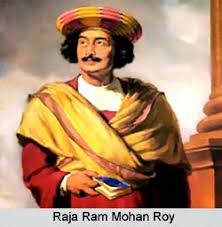
Personal Information
- Date of Birth: 22 May 1772
- Place of Birth: Radhanagar village, Hooghly district, Bengal Presidency (present-day West Bengal, India)
- Date of Death: 27 Sep 1833
- Place of Death: Stapleton, near Bristol, England (United Kingdom)
- Nationality: Indian
- Occupation: Social Reformer, Philosopher, Religious Thinker, Scholar, Writer, Journalist, Political Activist
- Era: Indian Renaissance, Early 19th Century India, Pre-1857 Freedom Movement, Colonial British India
Summary
Biography
Raja Ram Mohan Roy stands as one of the most influential figures in Indian history, remembered as the architect of the Indian Renaissance and a pioneer of social, religious, and intellectual reform. His life marked a turning point in India’s transition from medieval traditions to modernity. At a time when Indian society was burdened by rigid customs, superstition, and social injustices, Raja Ram Mohan Roy emerged as a fearless reformer who combined deep knowledge of Indian scriptures with modern rational thought.
Early Life and Family Background
Raja Ram Mohan Roy was born on 22 May 1772 in Radhanagar village of the Hooghly district in Bengal. He belonged to a well-to-do Bengali Brahmin family. His father, Ramkanta Roy, was an orthodox Brahmin who strictly followed traditional Hindu customs, while his mother, Tarini Devi, was deeply religious. This contrast between orthodoxy and devotion deeply influenced Roy’s intellectual development.
From an early age, Raja Ram Mohan Roy displayed exceptional intellectual abilities. He received traditional education in Sanskrit, Persian, and Arabic, which allowed him to study Hindu scriptures, Islamic theology, and philosophy. Later, he also learned English, Latin, and Greek, giving him access to Western philosophy, science, and political thought. This unique blend of Eastern and Western education shaped his reformist outlook.
Exposure to Diverse Religions and Ideas
Raja Ram Mohan Roy’s exposure to multiple religions helped him develop a comparative and rational approach to faith. He studied the Upanishads, Vedas, Quran, Bible, and other religious texts. Through this study, he concluded that the core message of all religions was belief in one supreme God and ethical living. He strongly opposed idol worship, rituals, and practices that promoted superstition and social inequality.
His belief in monotheism became the foundation of his reformist ideas. Roy argued that true religion should promote morality, rationality, and human dignity rather than blind faith.
Early Career and Administrative Experience
Raja Ram Mohan Roy worked with the British East India Company as a revenue officer and later as a private banker. This experience gave him insight into colonial administration, economic exploitation, and the social condition of Indians under British rule. Although he was not a revolutionary freedom fighter in the conventional sense, his intellectual resistance laid the ideological groundwork for India’s freedom movement.
He believed that political freedom could not be achieved without social reform and intellectual awakening. Therefore, he focused on transforming society from within.
Fight Against Social Evils – Abolition of Sati
One of Raja Ram Mohan Roy’s most significant contributions was his relentless campaign against the practice of Sati, in which widows were forced to immolate themselves on their husband’s funeral pyre. Deeply disturbed by this inhuman custom—witnessed within his own extended family—Roy decided to challenge it openly.
Using scriptural evidence, he proved that Sati had no sanction in Hindu religious texts. He wrote pamphlets, organized debates, and appealed to both Indian society and British authorities. His efforts bore fruit when Governor-General Lord William Bentinck passed the Bengal Sati Regulation Act in 1829, officially abolishing the practice.
This historic reform saved countless lives and marked the beginning of legislative social reform in India.
Advocate of Women’s Rights
Raja Ram Mohan Roy was a strong advocate for women’s empowerment. At a time when women were denied education, property rights, and dignity, he championed their cause fearlessly. He supported widow remarriage, women’s education, and inheritance rights.
Roy believed that a society could not progress unless its women were educated and respected. His views were revolutionary and laid the foundation for later women reform movements in India.
Promotion of Modern Education
Education reform was another pillar of Raja Ram Mohan Roy’s mission. He strongly opposed the traditional system of education that focused only on religious scriptures and rituals. Instead, he advocated for modern, scientific education.
In 1817, he played a key role in establishing the Hindu College (now Presidency University) in Calcutta. He supported the introduction of subjects such as mathematics, science, philosophy, and English literature. Roy believed that modern education would help Indians develop rational thinking and resist colonial domination intellectually.
He also supported the teaching of English, not as a means of cultural surrender, but as a tool to access global knowledge and modern ideas.
Journalism and Freedom of the Press
Raja Ram Mohan Roy understood the power of the press as a medium for social change. He started several newspapers and journals in Bengali, Persian, and English, including Sambad Kaumudi and Mirat-ul-Akbar. Through these publications, he criticized social evils, promoted reformist ideas, and demanded freedom of expression.
When the British government imposed restrictions on the press, Roy protested strongly, making him one of the earliest advocates of press freedom in India.
Formation of Brahmo Samaj
In 1828, Raja Ram Mohan Roy founded the Brahmo Samaj, a reformist religious movement aimed at purifying Hinduism. The Brahmo Samaj rejected idol worship, caste discrimination, and meaningless rituals. It emphasized monotheism, reason, moral values, and social reform.
The Brahmo Samaj became a powerful platform for intellectual debate and social reform, influencing later reformers such as Debendranath Tagore and Keshab Chandra Sen.
Political Thought and National Consciousness
Although Raja Ram Mohan Roy lived before the rise of mass nationalism, his ideas deeply influenced India’s freedom struggle. He believed in constitutional reform, rule of law, and individual rights. He demanded equal treatment of Indians under British rule and criticized racial discrimination.
Roy’s political writings reflected a deep understanding of liberty, justice, and human rights. He supported reforms that would empower Indians economically and socially.
Visit to England and Final Years
In 1830, Raja Ram Mohan Roy traveled to England as an ambassador of the Mughal Emperor Akbar II, who conferred upon him the title of “Raja.” His mission was to ensure that the British government did not repeal the ban on Sati and to represent Indian interests.
During his stay in England, Roy impressed scholars and intellectuals with his wisdom and knowledge. He engaged in discussions on religion, politics, and education, earning respect as a global thinker.
Unfortunately, his health deteriorated, and he passed away on 27 September 1833 in Stapleton, near Bristol. His tomb in England stands as a symbol of Indo-Western intellectual exchange.
Legacy and Impact
Raja Ram Mohan Roy’s legacy is immeasurable. He transformed Indian society by challenging oppressive traditions and introducing rational thought. He laid the foundations of modern education, women’s rights, religious reform, journalism, and social justice in India.
He is rightly remembered as the Father of the Indian Renaissance and a pioneer of modern Indian thought. His ideas continue to inspire reform, equality, and intellectual freedom.
Raja Ram Mohan Roy did not fight with weapons, but with ideas—and his intellectual revolution played a decisive role in shaping modern India.
