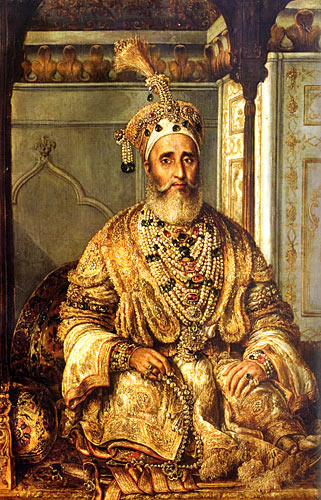
Personal Information
- Date of Birth: 27 Oct 1775
- Place of Birth: Shahjahanabad (Old Delhi), Mughal Empire (now Delhi, India)
- Date of Death: 07 Nov 1872
- Place of Death: Rangoon, British Burma (now Yangon, Myanmar)
- Nationality: Indian
- Occupation: Emperor, Poet, Patron of Arts, Political Figure, Symbolic Leader of Rebellion
- Era: 19th Century, Indian Rebellion of 1857, Last Mughal Era
Summary
Biography
Bahadur Shah Zafar, born Mirza Abu Zafar Siraj-ud-din Muhammad Bahadur Shah Zafar on 24 October 1775 in Shahjahanabad (Old Delhi), was the last Mughal Emperor of India. He ascended the throne in 1837 and ruled during a time when the Mughal Empire had lost almost all its political and military power, reduced to symbolic authority under British colonial dominance. Despite this, he became a central figure in the Indian Rebellion of 1857, symbolizing Indian resistance and nationalism.
Early Life and Education
Bahadur Shah Zafar was the second son of Emperor Akbar Shah II. He received traditional Mughal education in Persian literature, Islamic studies, calligraphy, and poetry. Zafar developed a lifelong passion for literature, particularly Urdu poetry, becoming an accomplished poet and patron of the arts. His poetic works reflected themes of love, spirituality, and melancholy, earning him a reputation as the “Poet Emperor.”
Growing up in the declining Mughal court, Zafar witnessed the erosion of his family’s political power and the increasing dominance of the British East India Company. Despite the limitations imposed by the British, he maintained the dignity and traditions of the Mughal dynasty.
Ascension to the Throne
In 1837, Bahadur Shah Zafar ascended the Mughal throne after the death of his father, Akbar Shah II. By this time, the Mughal Empire was largely symbolic, with real power in the hands of the British. Zafar’s role was largely ceremonial, but he continued to serve as a cultural and spiritual leader for the people of Delhi.
Though politically weak, Zafar attempted to preserve the traditions of the Mughal court, supporting art, poetry, and literature. His court became a hub for poets, scholars, and musicians, keeping alive the cultural legacy of the Mughal dynasty.
Role in the Indian Rebellion of 1857
During the Indian Rebellion of 1857, Bahadur Shah Zafar became the symbolic leader of the uprising against British rule. Rebels in Delhi declared him their emperor, seeking to unite Indian soldiers (sepoys) and local rulers under his leadership. Though he lacked real military power, Zafar’s position as a Mughal symbol provided legitimacy to the rebellion.
Zafar tried to mediate between the rebel factions and maintain order in Delhi. Despite his best efforts, the rebellion was poorly coordinated, and internal divisions weakened the resistance. Nevertheless, his leadership inspired many to fight against colonial oppression.
Capture and Exile
After the British recaptured Delhi in September 1857, Bahadur Shah Zafar was captured by the British. He was tried for treason and involvement in the rebellion. In 1858, he was exiled to Rangoon, Burma (now Yangon, Myanmar), along with his family. In exile, he lived in humble conditions, separated from his homeland and the people he had symbolically led.
Zafar spent his final years in Rangoon, continuing to write poetry and reflect on the decline of the Mughal dynasty. He passed away on 7 November 1862, marking the official end of the Mughal Empire in India. His death symbolized the transition of India into full British colonial rule.
Legacy and Historical Significance
Bahadur Shah Zafar is remembered as the last Mughal Emperor and a symbol of resistance against British rule. While his political power was limited, his leadership during the 1857 rebellion provided legitimacy and inspiration to Indian soldiers and freedom fighters. He is celebrated for his courage, dignity, and devotion to cultural preservation.
Zafar’s poetry remains an important part of Urdu literature, reflecting his emotional depth, spiritual contemplation, and experiences of loss and exile. His works continue to be studied for their literary and historical significance.
Cultural Impact
Bahadur Shah Zafar’s life and legacy have been immortalized in history books, literature, films, and folk traditions. Monuments and memorials in Delhi and Rangoon commemorate his contributions and tragic exile. His poetry and personal story serve as a reminder of India’s struggle against colonial domination and the resilience of its people.
Conclusion
Bahadur Shah Zafar (1775–1862) was the last Mughal Emperor, a poet, and a symbolic leader of the Indian Rebellion of 1857. Though politically powerless, he became a unifying figure for rebels and a symbol of Indian nationalism. Exiled to Rangoon, he spent his final years reflecting on his lost empire while leaving behind a rich legacy of literature, culture, and inspiration. Zafar’s life embodies the dignity, courage, and resilience of India’s historical struggle against colonial rule.
