Summary
Biography
Introduction
Shurpanakha is one of the most intriguing female characters in the Ramayana. As the sister of Ravana, the king of Lanka, she plays a crucial role in the events that lead to the central conflict of the epic: the abduction of Sita. Shurpanakha’s life exemplifies how desire, impulsiveness, and ego can set off a chain of events with profound consequences. Though often remembered for her negative actions, her story provides important moral and philosophical lessons about self-control, anger, and the ramifications of unchecked passion.
Birth and Lineage
Shurpanakha was born into the Rakshasa lineage as the daughter of Vishrava, a sage, and Kaikesi, a Rakshasi. This lineage made her the half-sister of Ravana, Kumbhakarna, and Vibhishana, each of whom would play critical roles in the Ramayana.
Shurpanakha inherited the physical strength, magical abilities, and temperamental disposition characteristic of the Rakshasas. She was known for her beauty in youth and her fiery, impulsive nature, traits that would later influence her interactions with key characters in the epic.
Personality and Traits
Shurpanakha is depicted as:
- Impulsive and passionate: She acts according to her desires without considering consequences.
- Manipulative and cunning: She uses her charm and threats to influence others.
- Fierce and powerful: She possesses supernatural strength and the ability to intimidate even seasoned warriors.
These traits make her a formidable character, whose personal actions trigger significant events in the Ramayana.
Encounter with Rama and Lakshmana
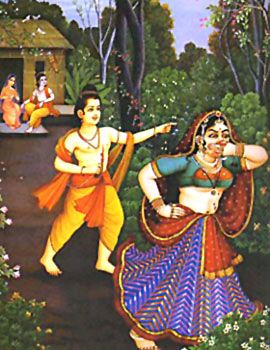
Shurpanakha’s most famous episode occurs when she encounters Rama and Lakshmana in the forest during their exile. Captivated by Rama’s looks, she expresses her desire to marry him. When Rama politely declines, citing his devotion to Sita, Shurpanakha becomes enraged.
She then approaches Lakshmana with similar intentions, only to be rejected and humiliated. In a fit of rage, Shurpanakha attempts to attack Sita out of jealousy. This confrontation leads to Lakshmana cutting off her nose and ears, a pivotal moment that escalates the conflict between Rama and Ravana.
Motivation Behind the Actions
Shurpanakha’s behavior reflects the consequences of uncontrolled desire and pride. Her initial attraction to Rama, compounded by rejection and humiliation, leads to violent retaliation. This sequence of events ultimately provides Ravana the motivation to abduct Sita, believing it will avenge his sister’s insult.
Her actions serve as a narrative catalyst, demonstrating how personal ego and impulsiveness can have far-reaching effects beyond immediate intentions.
Relationship with Ravana
After her mutilation, Shurpanakha returns to Lanka and informs her brother Ravana of her humiliation. Her account, filled with exaggeration and anger, provokes Ravana to plan the abduction of Sita, believing it to be an affront to his family’s honor.
Although she does not directly participate in the abduction, Shurpanakha’s instigation highlights the influence of desire and anger in shaping major events within the epic.
Moral and Philosophical Significance
Shurpanakha’s story provides several important moral lessons:
- Uncontrolled desire can lead to destruction: Her infatuation with Rama indirectly causes the central conflict of the Ramayana.
- Ego and vengeance escalate conflicts: Her exaggerated report to Ravana demonstrates how pride can provoke disastrous decisions.
- Impulse versus reflection: Shurpanakha acts without considering consequences, illustrating the importance of restraint and wisdom.
Her narrative serves as a cautionary tale about the dangers of letting emotions dictate actions.
Cultural and Literary Legacy
Shurpanakha remains a widely discussed character in literature, folklore, and performing arts. She is often portrayed in dance dramas, plays, and retellings of the Ramayana as the catalyst of the epic’s central conflict.
Her character embodies the human-like flaws of Rakshasas, showing that even supernatural beings are subject to emotions like desire, jealousy, and pride.
Symbolism
Shurpanakha symbolizes:
- Desire and temptation: Her infatuation with Rama demonstrates the power of attraction and its consequences.
- Instigation and consequences: Her actions indirectly lead to the abduction of Sita, showing how minor events can have major repercussions.
- Uncontrolled emotions: Her impulsiveness and rage serve as a warning about the dangers of letting anger and ego dominate behavior.
Through her, the Ramayana conveys lessons on restraint, moral choice, and the cascading effects of personal decisions.
Lessons from Shurpanakha’s Life
- Think before acting: impulsive decisions can have long-term consequences.
- Desire and jealousy can disrupt harmony and justice.
- Accountability for one’s actions is critical, even for powerful beings.
- Personal conflicts can escalate into larger social or moral crises if unchecked.
Conclusion
Shurpanakha, though often remembered negatively, is a vital character in the Ramayana. Her impulsive actions, driven by desire, ego, and anger, set into motion the chain of events leading to Sita’s abduction and the eventual war in Lanka. Beyond her role as Ravana’s sister, Shurpanakha serves as a symbolic figure demonstrating the dangers of unchecked emotion and the importance of self-restraint. Her life story continues to be an enduring lesson in morality, human psychology, and the consequences of desire-driven actions.