Summary
Biography
Introduction
Jatayu is one of the most emotionally powerful and morally inspiring characters in the Ramayana. Though not a king, warrior, or sage, Jatayu’s sacrifice occupies a sacred place in the epic. As a divine bird who stood against the mighty Ravana, Jatayu represents selfless courage, loyalty to righteousness, and the willingness to sacrifice one’s life for the protection of the innocent. His story demonstrates that true heroism is defined not by victory, but by intent, action, and moral resolve.
Birth and Lineage
Jatayu was born to Aruna, the celestial charioteer of the sun god Surya. Aruna is revered as a divine being who represents dawn and illumination, symbolizing awakening and clarity. Jatayu’s lineage placed him among the divine beings who moved freely between heaven and earth.
Jatayu also had a brother named Sampati, who later played a crucial role in helping Lord Rama locate Goddess Sita. Together, the brothers were known for their strength, speed, and loyalty to dharma.
Relationship with King Dasharatha
Jatayu shared a close bond with King Dasharatha, the father of Lord Rama. The two were friends, and Jatayu held deep affection and respect for Rama as the son of his beloved companion.
Because of this relationship, Jatayu regarded Rama, Sita, and Lakshmana not merely as figures of royalty, but as family. This emotional bond played a crucial role in Jatayu’s decision to confront Ravana.
Encounter with Ravana
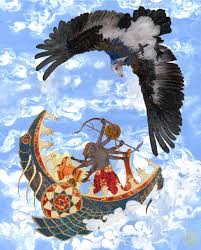
The defining moment of Jatayu’s life occurred when Ravana abducted Goddess Sita in his flying chariot. Witnessing this crime, Jatayu immediately intervened.
Despite his advanced age, Jatayu confronted Ravana in mid-air and challenged him to release Sita. Jatayu fought fiercely, damaging Ravana’s chariot and weapons. His courage lay not in the expectation of victory, but in his refusal to remain silent in the face of injustice.
The Battle and Sacrifice
The battle between Jatayu and Ravana was unequal. Ravana, armed with divine weapons and immense strength, eventually severed Jatayu’s wings, causing him to fall to the earth.
Mortally wounded, Jatayu lay waiting, sustained only by his determination to fulfill his duty. His sacrifice was not in vain, as it delayed Ravana and demonstrated resistance against adharma.
Meeting with Rama and Lakshmana
When Lord Rama and Lakshmana discovered Jatayu in his final moments, Jatayu gathered his remaining strength to inform Rama about Sita’s abduction and Ravana’s direction.
Rama was deeply moved by Jatayu’s sacrifice. He mourned Jatayu as he would his own father, performing the last rites with profound respect and grief. This moment underscores Jatayu’s elevated status in the epic.
Spiritual Significance of Jatayu’s Death
Jatayu’s death is not portrayed as a defeat, but as a spiritual victory. He died protecting dharma, which granted him liberation and eternal honor.
In many traditions, it is believed that Jatayu attained moksha due to his selfless act. His life demonstrates that devotion expressed through action is as powerful as ritual or meditation.
Symbolism and Philosophical Meaning
Jatayu symbolizes fearless righteousness. He teaches that age, physical limitation, or lack of power should never prevent one from standing against injustice.
His willingness to confront Ravana without hesitation highlights the moral duty of bystanders to intervene when wrongdoing occurs. Jatayu’s story reinforces the idea that silence in the face of evil is itself a form of injustice.
Cultural and Religious Legacy
Jatayu is revered across India, with temples, sculptures, and folklore honoring his sacrifice. He is especially remembered in regions associated with Rama’s exile.
His story is often used to teach values of courage, compassion, and moral responsibility to students and devotees.
Jatayu and Environmental Symbolism
In modern interpretations, Jatayu is also seen as a symbol of harmony between nature and dharma. As a bird who sacrificed himself for righteousness, he represents the role of nature as a moral witness to human actions.
This perspective has contributed to Jatayu’s relevance in contemporary ethical discussions.
Lessons from Jatayu’s Life
Jatayu’s life teaches that righteousness does not require success, only sincere effort. His sacrifice reminds humanity that protecting the innocent is a sacred duty.
He also demonstrates that true honor comes from action guided by conscience, not from power or position.
Conclusion
Jatayu stands as one of the greatest martyrs of the Ramayana. A noble bird who chose sacrifice over silence, he embodied the highest ideals of dharma. His courage in confronting Ravana, his loyalty to Rama, and his final act of service ensure that his name remains eternal. Jatayu’s story continues to inspire generations to stand for justice, regardless of personal cost.