Summary
Biography
Introduction
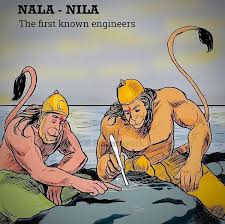
Nala is one of the most remarkable yet often underappreciated figures in the ancient Indian epic Ramayana. Known primarily as the chief architect and engineer of the Vanara army, Nala played a decisive role in Lord Rama’s campaign against the demon king Ravana. His most significant contribution was the construction of the legendary Ram Setu, the bridge across the ocean that enabled Rama and his allies to reach Lanka and rescue Goddess Sita. Nala’s character represents intelligence guided by devotion, discipline in service, and the application of knowledge for a righteous cause.
Birth and Divine Lineage
Nala was born to Lord Vishwakarma, the celestial architect and engineer of the gods. Vishwakarma is revered in Hindu tradition as the creator of divine weapons, palaces, celestial cities, and advanced architectural designs. As the son of such a divine being, Nala inherited extraordinary knowledge of construction, planning, and material science.
This divine lineage made Nala uniquely capable of performing feats that surpassed ordinary physical limitations. His understanding of balance, structure, and natural elements was far ahead of his time, establishing him as one of the earliest representations of a civil engineer in ancient literature.
Childhood Curse and Its Transformation
According to traditional accounts in the Ramayana, Nala was once cursed during his childhood that whatever he touched would sink in water. This curse initially appeared to be a severe limitation and a source of misfortune. However, as the epic unfolds, this curse transforms into a blessing through divine intervention.
When Lord Rama needed a bridge to cross the ocean, Nala’s curse reversed due to Rama’s grace. Instead of sinking, the stones and materials handled by Nala began to float on water. This transformation symbolizes an important philosophical idea in Hindu thought: that obstacles faced by righteous individuals can become instruments of success when aligned with dharma and divine will.
Role in the Vanara Army
During Lord Rama’s exile and his search for Goddess Sita, Nala emerged as a trusted and indispensable ally. When the Vanara king Sugriva organized his forces to assist Rama, Nala was appointed as the chief architect of the army.
His responsibilities included planning logistics, organizing manpower, selecting suitable construction materials, and ensuring structural stability. Unlike warriors who fought on the battlefield, Nala’s contribution lay in preparation and execution, without which victory would have been impossible.
Construction of Ram Setu
The construction of Ram Setu, also known as Setubandhanam, stands as the greatest achievement of Nala’s life. The bridge connected the southern coast of India, near present-day Rameswaram, to the island of Lanka.
Under Nala’s leadership, thousands of Vanaras worked in coordination to gather stones, trees, and other materials. Nala carefully supervised the placement of each component, ensuring balance and continuity. The bridge was reportedly completed in five days, an extraordinary feat considering the scale and environmental challenges.
Stones inscribed with the name of Rama floated on water, symbolizing the power of devotion combined with skill. Nala’s engineering genius transformed faith into a practical reality, allowing the Vanara army to cross the ocean safely.
Devotion to Lord Rama
Despite his immense talent and divine heritage, Nala remained humble and devoted to Lord Rama. He never sought personal recognition or praise. His actions were motivated purely by service to dharma and loyalty to Rama.
Nala consistently acknowledged that his success was possible only because of Rama’s blessings. This humility sets him apart as a character who embodies the ideal balance between knowledge and surrender, skill and devotion.
Symbolism and Philosophical Significance
Nala’s character holds deep symbolic meaning in the Ramayana. He represents the idea that intellect must serve righteousness. His life demonstrates that knowledge without ego becomes a powerful force for good.
The transformation of his curse into a blessing illustrates the Hindu belief that destiny can be reshaped through divine grace and selfless action. Nala also represents the harmony between science and spirituality, showing that ancient Indian thought did not separate technical knowledge from moral responsibility.
Cultural and Historical Importance
Nala is often regarded as one of the earliest symbolic representations of engineering and architecture in Indian literature. His story reflects an advanced understanding of teamwork, project management, and natural forces.
The Ram Setu itself continues to be a subject of cultural, historical, and scientific discussion. Regardless of interpretations, Nala’s role as its builder has secured his place in Indian cultural memory.
Legacy
Nala’s legacy endures through religious texts, folklore, and temple traditions. He is remembered not as a warrior, king, or sage, but as a servant whose intelligence shaped the outcome of a cosmic battle.
His life inspires engineers, students, and devotees to use their skills for the welfare of society. Nala teaches that true greatness lies not in power or fame, but in purposeful service guided by righteousness.
Conclusion
Nala stands as a timeless figure in the Ramayana, representing the strength of knowledge aligned with devotion. As the divine architect who built Ram Setu, he played a crucial role in the victory of good over evil. His biography reminds humanity that even the most challenging obstacles can be overcome when wisdom, humility, and faith work together. Nala’s story continues to inspire generations as a model of selfless service, technical excellence, and unwavering devotion to dharma.