Summary
Biography
Introduction
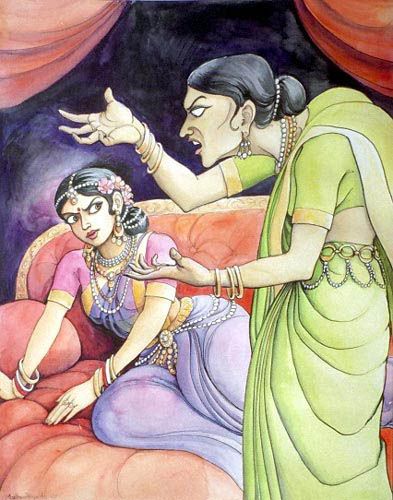
Manthara is one of the most notorious yet pivotal characters in the Ramayana. She is remembered for her cunning, intelligence, and manipulative abilities, which played a crucial role in shaping the central events of the epic. As the loyal maid of Queen Kaikeyi, Manthara exploited her influence over the queen to serve her own objectives and those of Kaikeyi, ultimately leading to the exile of Lord Rama. While often vilified, Manthara’s story provides important lessons about strategy, persuasion, and the consequences of personal ambition.
Early Life and Background
The Ramayana does not provide extensive details about Manthara’s early life, but she is traditionally described as a clever and experienced maid in the royal palace of King Dasharatha of Ayodhya. She served Kaikeyi, one of Dasharatha’s queens, with unwavering loyalty, gaining both trust and influence over the queen.
Manthara’s intelligence and shrewdness allowed her to understand the dynamics of the royal family and recognize opportunities to manipulate outcomes in her favor. Her keen observation skills and persuasive abilities made her a critical player in the unfolding drama of the Ramayana.
Personality and Traits
Manthara is characterized by several distinct traits:
- Cunning and strategic thinking: She carefully plans her actions to achieve desired outcomes.
- Persuasive and influential: She skillfully manipulates Kaikeyi to act according to her suggestions.
- Ambitious and self-serving: She seeks to secure the position and interests of Kaikeyi and herself.
- Perceptive and observant: She identifies weaknesses in others and exploits them to her advantage.
Her intelligence and strategic acumen, though often used for negative purposes, highlight her sharp mind and deep understanding of human psychology.
Role in the Ramayana
Manthara’s most significant contribution to the epic occurs when she incites Queen Kaikeyi to demand that King Dasharatha exile Lord Rama and crown her son Bharata as king. Observing that Kaikeyi’s affection for Rama might interfere with Bharata’s succession, Manthara manipulates the queen by emphasizing fears, insecurities, and ambitions.
Manthara plays on Kaikeyi’s emotions, portraying Rama’s coronation as a threat to her son’s position and future. Her constant advice and manipulation ultimately persuade Kaikeyi to invoke the boons granted to her by Dasharatha, demanding Rama’s exile to the forest for fourteen years and Bharata’s crowning as king.
Consequences of Manthara’s Actions
Manthara’s scheming sets off a chain of events that shape the central narrative of the Ramayana:
- Rama’s exile: As a result of Kaikeyi’s decision, Rama is sent into exile, beginning his journey of trials, growth, and eventual triumph.
- Conflict within the royal family: Dasharatha is heartbroken, Kaikeyi faces guilt, and Bharata struggles with the legitimacy of his kingship.
- Moral and ethical lessons: Manthara’s actions highlight the destructive potential of manipulation, jealousy, and unchecked ambition.
Her influence demonstrates how a single individual, even one in a subordinate position, can alter the course of history through persuasion and strategy.
Interaction with Rama
Though Manthara does not directly confront Rama, her presence and actions are critical in shaping his life. By orchestrating his exile, she indirectly facilitates Rama’s growth, valor, and the eventual restoration of dharma. In this sense, Manthara’s role, though negative, is a catalyst for Rama’s heroism and the unfolding of divine destiny.
Moral and Philosophical Significance
Manthara’s story offers several important lessons:
- Influence carries responsibility: The power to shape decisions should be exercised wisely.
- Manipulation can have far-reaching consequences: Her persuasion led to immense suffering and turmoil in the royal family.
- Ambition without morality leads to downfall: Though clever, Manthara’s actions are morally questionable and serve as a cautionary tale.
- Catalyst for destiny: Even actions motivated by selfishness can inadvertently serve a higher purpose.
Her character underscores the Ramayana’s exploration of human psychology, ethics, and the consequences of personal ambition.
Cultural and Literary Legacy
Manthara is widely referenced in literature, folklore, and dramatic performances of the Ramayana. She represents the archetype of the scheming advisor whose influence can have profound consequences. In traditional performances, Manthara’s character is portrayed as cunning, witty, and calculating, serving both as a narrative device and moral lesson.
Symbolism
Manthara symbolizes:
- Manipulation and cunning: The use of intelligence for personal or selfish gain.
- Influence and persuasion: How subtle advice can alter major events.
- The power of subordinate roles: Even those without official authority can shape destiny.
- Catalyst of trials: Her actions set the stage for Rama’s heroism and adherence to dharma.
Through Manthara, the Ramayana illustrates that individuals’ actions, whether righteous or selfish, can profoundly impact the moral and social order.
Lessons from Manthara’s Life
- Exercise caution in giving and receiving advice.
- Recognize that ambition and manipulation can have unintended consequences.
- Understand that even seemingly negative actions may inadvertently fulfill a greater moral or divine plan.
- Influence should be tempered with ethics and consideration of long-term effects.
Conclusion
Manthara, though a minor character in terms of official status, plays a pivotal role in the Ramayana. Her manipulation of Queen Kaikeyi led to Rama’s exile, shaping the epic’s central narrative and testing the strength, patience, and dharma of its heroes. While she is often remembered negatively, her life offers important lessons on influence, ambition, and the consequences of scheming. Manthara’s story remains a timeless example of how intellect and persuasion, if misused, can trigger significant events and moral challenges.