Summary
Biography
Introduction
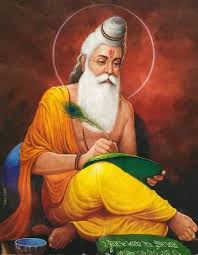
Maharishi Valmiki holds an unparalleled position in Indian spiritual and literary history. Revered as the Adi Kavi, meaning the first poet, Valmiki is the author of the Ramayana, one of the greatest epics ever composed. His life is not only a story of literary genius but also a profound spiritual transformation. Valmiki’s journey from a life of violence and ignorance to enlightenment and divine creativity stands as a timeless example of redemption, self-realization, and devotion to dharma.
Early Life and Origin
According to traditional accounts, Valmiki was not born a sage. In his early life, he was known as Ratnakara, a man who lived by robbing travelers in forests to support his family. His life was driven by survival, ignorance, and moral blindness rather than cruelty for its own sake.
Ratnakara believed his actions were justified because he committed crimes for the sake of his family. This belief would later be challenged in a life-altering encounter.
Encounter with Sage Narada
The turning point in Valmiki’s life occurred when he encountered Sage Narada, the divine sage and celestial musician. Narada questioned Ratnakara about whether his family would share the burden of his sins.
When Ratnakara asked his family, they refused responsibility, stating that each individual bears the consequences of their own actions. This realization shattered Ratnakara’s justification for his crimes and awakened a deep sense of remorse.
Narada advised him to meditate and chant the divine name of Rama as a path toward purification.
Transformation Through Tapasya
Unable to pronounce the name “Rama” due to his past, Ratnakara began chanting “Mara,” which gradually transformed into “Rama” through continuous repetition. He entered deep meditation and performed intense tapasya for many years.
During this period, an anthill formed around his body, covering him completely. When he emerged from this long penance, he was transformed into a radiant sage. From this anthill, or valmika in Sanskrit, he received the name Valmiki.
This transformation symbolizes the Hindu belief that sincere repentance and devotion can elevate any individual, regardless of their past.
Attainment of Sagehood
After his spiritual awakening, Valmiki attained divine wisdom and became a revered sage. He was blessed by Lord Brahma with knowledge of poetry, meter, and divine insight.
Valmiki’s ashram became a center of learning, spiritual discourse, and compassion. He lived a life of simplicity, meditation, and service to dharma.
Birth of Sanskrit Poetry
Valmiki is credited with composing the first shloka in Sanskrit literature. According to tradition, this verse emerged spontaneously from Valmiki’s heart when he witnessed the killing of a male bird while its mate cried in grief.
This moment of compassion gave rise to poetic expression, marking the birth of Sanskrit poetry. It established Valmiki not only as a sage but also as the originator of literary expression grounded in emotion and morality.
Composition of the Ramayana
Valmiki’s greatest contribution to humanity is the Ramayana, an epic consisting of approximately 24,000 verses divided into seven kandas. The Ramayana narrates the life of Lord Rama, the ideal embodiment of dharma, truth, and righteousness.
Valmiki composed the Ramayana through divine inspiration and deep spiritual insight. The epic presents moral, social, and philosophical ideals through vivid storytelling.
Unlike mythological exaggeration, Valmiki’s Ramayana emphasizes human values, ethical dilemmas, and emotional depth, making it universally relatable.
Relationship with Sita and Lava-Kusha
After the war of Lanka, Goddess Sita took refuge in Valmiki’s ashram. Valmiki provided her shelter, protection, and respect during her exile.
Sita gave birth to Lava and Kusha in Valmiki’s ashram. Valmiki personally educated them in scriptures, warfare, ethics, and music. He also taught them the Ramayana, which they later recited in King Rama’s court.
This episode highlights Valmiki’s role not only as a poet but also as a teacher, guardian, and moral guide.
Valmiki’s Philosophy and Teachings
Valmiki’s teachings emphasize compassion, righteousness, restraint, and devotion. His life illustrates that dharma is accessible to all who seek it sincerely.
He rejected caste-based superiority and demonstrated that spiritual elevation depends on actions, not birth.
Cultural and Literary Legacy
Valmiki’s Ramayana has shaped Indian civilization for thousands of years. It influenced literature, art, dance, governance, ethics, and social values across South and Southeast Asia.
Numerous regional versions of the Ramayana draw inspiration from Valmiki’s original composition, affirming his enduring influence.
Symbolism and Spiritual Significance
Valmiki symbolizes transformation and hope. His life reassures humanity that no one is beyond redemption.
He represents the unity of spirituality and creativity, showing that divine wisdom can flow through artistic expression.
Lessons from Valmiki’s Life
Valmiki’s life teaches that realization begins with self-questioning. It demonstrates the power of discipline, meditation, and devotion.
He reminds us that greatness arises from humility and inner change, not social status or power.
Conclusion
Maharishi Valmiki stands as one of the greatest sages in human history. As the Adi Kavi and author of the Ramayana, he shaped the moral and spiritual foundation of Indian civilization. His journey from Ratnakara to Valmiki remains one of the most powerful stories of transformation ever told. Through his life and works, Valmiki continues to guide humanity toward truth, compassion, and dharma.