Personal Information
- Place of Birth: 1047 CE, Kalinganagara, Kalinga Kingdom (present-day Odisha, India)
- Place of Death: 1150 CE, Kalinga Empire (present-day Odisha, India)
- Era: Medieval India (11th–12th Century CE)
Summary
Biography
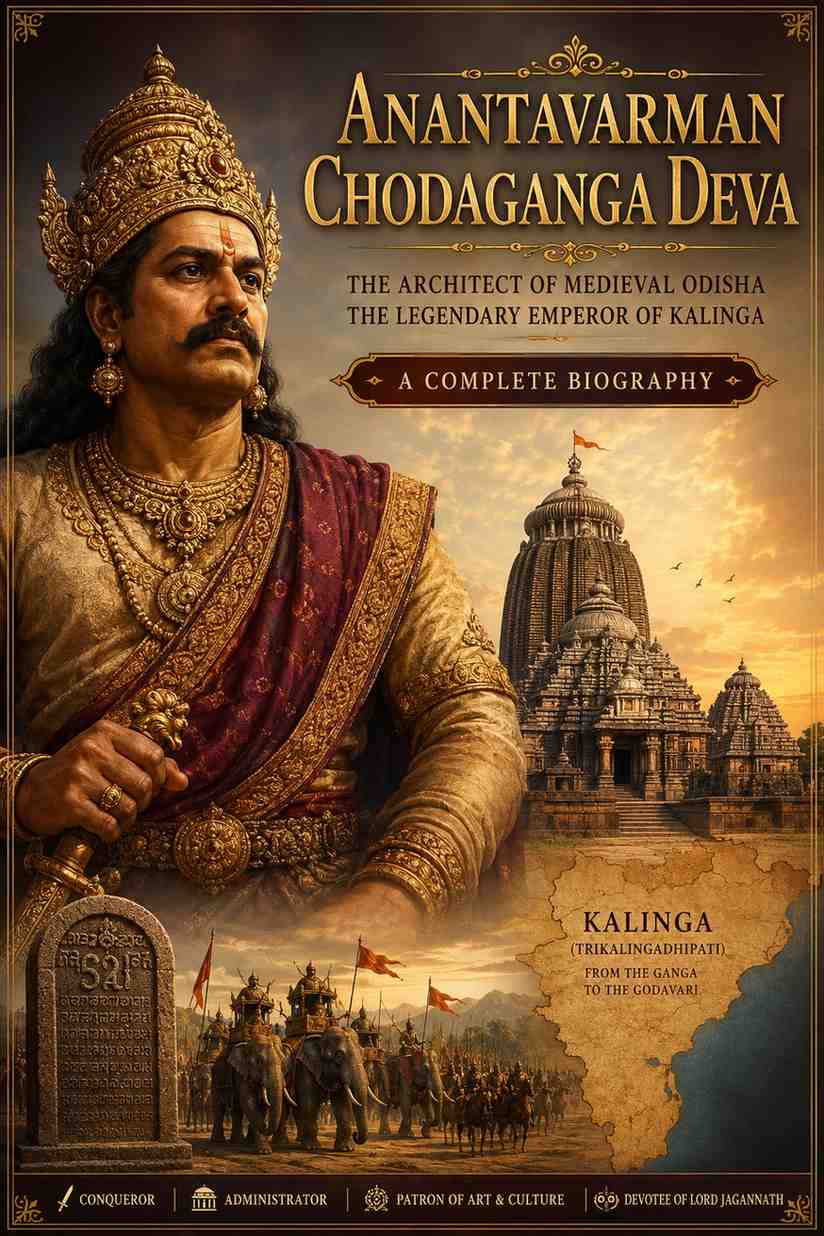
Anantavarman Chodaganga Deva was one of the most distinguished rulers in the history of Odisha and medieval India. He is remembered as the greatest emperor of the Eastern Ganga Dynasty, a ruler whose military achievements, administrative abilities, religious devotion, and cultural patronage transformed the political and cultural landscape of eastern India. His reign, which lasted from approximately 1078 CE to 1150 CE, marked the beginning of a golden age for Kalinga and laid the foundation for the rise of Odisha as a powerful and culturally vibrant kingdom. He is especially renowned for initiating the construction of the grand Jagannath Temple at Puri, a monument that remains one of the most sacred pilgrimage sites in Hinduism and a symbol of Odia identity.
Anantavarman Chodaganga Deva was born into a royal family that combined two of the most influential dynasties of southern and eastern India. His father, Rajaraja Deva I, belonged to the Eastern Ganga Dynasty, which had ruled parts of Kalinga for several centuries. His mother, Rajasundari, was a princess of the mighty Chola Dynasty of South India. This unique lineage connected him to two powerful royal traditions and helped shape his political outlook and ambitions. Through his maternal heritage, he inherited cultural and political influences from the Cholas, while through his paternal lineage, he inherited the legacy of the Gangas, who had long sought to establish their supremacy over Kalinga.
When Anantavarman ascended the throne in 1078 CE, the political situation in eastern India was complex and challenging. Kalinga was divided among various regional powers, and neighboring kingdoms frequently competed for territory and influence. The Eastern Ganga kingdom itself faced threats from the Cholas in the south, the Somavamsis in the west, and other regional rulers who sought to exploit political instability. The young king inherited a realm that required strong leadership, military skill, and administrative reform. Demonstrating remarkable determination and intelligence, Anantavarman began consolidating his authority and strengthening the foundations of his kingdom.
One of the most significant achievements of Anantavarman Chodaganga Deva was the political unification of Kalinga. Through a series of successful military campaigns, he expanded the boundaries of his kingdom and brought several neighboring territories under his control. He defeated rival rulers, subdued rebellious chiefs, and established a centralized authority that extended across vast regions of eastern India. His conquests included the incorporation of Utkala and parts of Kosala, enabling him to unite territories that had long remained politically fragmented. This achievement was not merely a military success; it was a transformative event that helped create a stronger regional identity and paved the way for the future development of Odisha as a unified cultural and political entity.
The emperor's military campaigns demonstrated exceptional strategic planning and leadership. Historical inscriptions describe him as a powerful warrior who commanded large armies consisting of infantry, cavalry, war elephants, and naval forces. His victories expanded the Eastern Ganga Empire from the Ganga River region in the north to the Godavari River in the south. Such an extensive realm brought considerable wealth, resources, and prestige to the dynasty. His military success earned him several honorific titles, including "Trikalingadhipati," meaning "Lord of the Three Kalingas," signifying his authority over the major divisions of the Kalinga region. These titles reflected not only his territorial achievements but also his status as one of the most powerful rulers of his time.
Anantavarman Chodaganga Deva was not merely a conqueror; he was also a capable administrator who understood the importance of stable governance. He established an efficient administrative system that allowed him to govern a large and diverse empire. The kingdom was divided into provinces, districts, and villages, each supervised by appointed officials responsible for maintaining law and order, collecting revenue, and implementing royal policies. The emperor ensured that local administrations functioned effectively while remaining accountable to the central authority. This balance between local governance and centralized control contributed significantly to the stability and prosperity of the empire.
Revenue administration formed a crucial aspect of his governance. Agriculture served as the backbone of the economy, and land revenue constituted a major source of state income. The emperor encouraged agricultural development by supporting irrigation projects, improving land management practices, and ensuring the protection of farmers. Trade also flourished during his reign due to the strategic location of Kalinga along important maritime and overland trade routes. Merchants engaged in commercial activities with various regions of India and foreign lands across the Bay of Bengal. The prosperity generated through agriculture and trade enabled the state to fund public works, military campaigns, religious institutions, and cultural activities.
Religion played a central role in the life and reign of Anantavarman Chodaganga Deva. He was a devout Hindu and actively supported religious institutions throughout his empire. His religious policies reflected both personal devotion and a broader vision of cultural integration. Although influenced by Shaivism during parts of his life, he is particularly associated with the worship of Lord Jagannath, a deity who would later become the spiritual symbol of Odisha. The emperor recognized the unifying potential of the Jagannath tradition and promoted it as a major religious institution within his kingdom.
His most enduring contribution to religion and architecture was the initiation of the construction of the magnificent Jagannath Temple at Puri. Before his reign, the worship of Jagannath already existed in various forms, but Anantavarman sought to establish a grand temple worthy of the deity's growing importance. The temple project represented not only a religious undertaking but also a political and cultural statement. By sponsoring such a monumental structure, the emperor demonstrated his devotion, strengthened royal legitimacy, and fostered a shared cultural identity among his subjects. Although subsequent rulers completed portions of the temple complex, Anantavarman is widely credited with beginning the construction of the present temple structure. Today, the Jagannath Temple stands as one of India's most celebrated religious monuments and remains closely associated with his legacy.
The emperor's patronage extended beyond religion into the fields of art, architecture, literature, and education. His reign witnessed significant advancements in temple construction and artistic expression. The architectural traditions developed during his rule influenced later generations of builders and contributed to the emergence of the distinctive Kalinga style of temple architecture. Sculptors, craftsmen, scholars, and poets received royal support, enabling cultural activities to flourish throughout the empire. The artistic achievements of the Eastern Ganga period continue to be admired for their elegance, technical excellence, and spiritual depth.
Literature and scholarship also benefited from his patronage. Sanskrit remained an important language of administration, religion, and intellectual discourse during his reign. Scholars and religious teachers found encouragement at the royal court, contributing to the production and preservation of literary and philosophical works. The emperor understood that cultural development enhanced the prestige of the kingdom and strengthened its identity. Consequently, he promoted learning and intellectual activities alongside military and economic growth.
Another notable aspect of Anantavarman Chodaganga Deva's rule was his ability to integrate diverse communities within his expanding empire. The territories under his control included people of different linguistic, cultural, and religious backgrounds. Rather than relying solely on military force, he pursued policies that encouraged cooperation and loyalty among local elites and regional communities. This inclusive approach helped maintain stability across a vast geographical area and facilitated the emergence of a broader political and cultural unity.
The long duration of his reign contributed significantly to his success. Ruling for approximately seventy-two years, he enjoyed a level of continuity rarely seen in medieval history. This extended period allowed him to implement long-term policies, complete ambitious projects, and establish institutions that endured beyond his lifetime. His reign witnessed the transition of the Eastern Ganga kingdom from a regional power into a major imperial state. The stability provided by his leadership enabled economic growth, cultural development, and administrative refinement on an unprecedented scale.
Historical inscriptions from his reign provide valuable information about his achievements and character. These records portray him as a powerful monarch, a protector of dharma, a patron of religion, and a benefactor of his subjects. While royal inscriptions naturally emphasize the accomplishments of rulers, the consistency of references across multiple sources suggests that Anantavarman genuinely commanded widespread respect and admiration. His reputation extended beyond the boundaries of his kingdom, and neighboring rulers recognized his influence and authority.
The emperor's family life also reflected his political significance. He maintained alliances through royal marriages and had several queens and children who contributed to the continuity of the dynasty. His successors inherited a strong and prosperous empire that continued to play an important role in the history of eastern India. Although later rulers faced their own challenges, they benefited greatly from the foundations established during his reign.
Anantavarman Chodaganga Deva passed away around 1150 CE after one of the longest and most successful reigns in Indian history. His death marked the end of an extraordinary era, but his influence continued to shape the destiny of Odisha for centuries. The Eastern Ganga Dynasty remained a significant political force, and subsequent rulers expanded upon many of the institutions and traditions he had established. The cultural and religious developments initiated during his reign continued to flourish, contributing to the enduring legacy of the dynasty.
Today, Anantavarman Chodaganga Deva is remembered as one of the greatest kings in the history of Odisha. His achievements as a conqueror, administrator, patron of culture, and promoter of religion have secured him a permanent place in Indian history. The political unification of Kalinga, the strengthening of the Eastern Ganga Empire, the encouragement of trade and agriculture, the patronage of art and scholarship, and the initiation of the Jagannath Temple collectively define his remarkable legacy. More than eight centuries after his death, his contributions remain visible in the cultural traditions, religious practices, and historical consciousness of Odisha.
The story of Anantavarman Chodaganga Deva is ultimately the story of a ruler who combined military strength with cultural vision. He understood that lasting greatness required more than conquest alone. By investing in religion, architecture, administration, and public welfare, he created institutions and traditions that outlived his reign and enriched future generations. His life exemplifies the qualities of leadership, foresight, and dedication that characterize history's most influential monarchs. For these reasons, Anantavarman Chodaganga Deva continues to be celebrated as the architect of medieval Odisha, the founder of an imperial tradition, and one of the most remarkable rulers in the annals of Indian history.