Personal Information
- Place of Birth: 1470 CE, Cuttack, Odisha (approx.)
- Place of Death: 1540 CE, Puri, Odisha (approx.)
- Era: 1497–1540 CE, Medieval India
Summary
Biography
Prataparudra Deva, one of the most celebrated rulers of the Gajapati Dynasty of Odisha, ruled from 1497 to 1540 CE. He inherited a mighty empire built by his grandfather Kapilendra Deva and strengthened by his father Purushottama Deva. However, he also inherited growing political challenges and military threats from external powers. Prataparudra was not only a warrior and administrator but also a deeply spiritual king whose life became intertwined with the Bhakti movement, particularly through his relationship with Sri Chaitanya Mahaprabhu.
Born around 1470 CE in Cuttack, Prataparudra Deva grew up in a royal environment that blended military training with religious devotion. His father, Purushottama Deva, was known for his southern conquests and his devotion to Lord Jagannath, values that were instilled in the young prince. From childhood, Prataparudra was dedicated to spiritual practices, temple rituals, and learning Sanskrit scriptures, which later defined his reign.
Ascension to the Throne
After the death of Purushottama Deva in 1497 CE, Prataparudra Deva ascended the throne of the Gajapati Empire. The empire at this time stretched across:
- Odisha
- Northern Andhra Pradesh
- Eastern Telangana
- Parts of Bengal
- Some regions of Chhattisgarh
However, new threats were emerging from the Bengal Sultanate, the Qutb Shahi rulers of Golconda, and the Vijayanagara Empire, all of whom sought to challenge Odisha’s influence.
Military and Political Challenges
Conflict with Bengal Sultanate
One of the greatest challenges Prataparudra faced was the aggressive expansion of the Sultans of Bengal. Throughout the early 1500s, Bengal launched multiple attacks on Odisha’s northern borders.
Prataparudra successfully repelled several invasions and maintained Odisha’s independence during his early reign. His generals managed to protect crucial forts and coastal regions important for trade and defense.
Deccan and Vijayanagara Conflicts
The loss of southern territories, which had begun toward the end of his father’s reign, continued to intensify under Prataparudra. The Qutb Shahi dynasty of Golconda captured many of Odisha’s southern provinces. Similarly, the Vijayanagara Empire, which once had marital alliances with the Gajapatis, also reclaimed territories formerly under Odisha.
Despite military setbacks in the south, Prataparudra maintained firm control over the core region of Odisha and safeguarded the kingdom from complete fragmentation.
Association with Sri Chaitanya Mahaprabhu
Prataparudra Deva is world-famous for his deep spiritual connection with Sri Chaitanya Mahaprabhu, the great Vaishnava saint who initiated a massive devotional movement across India.
When Chaitanya Mahaprabhu visited Puri, Prataparudra expressed a strong desire to meet him. However, Chaitanya, who had renounced worldly life, did not agree to meet a king directly.
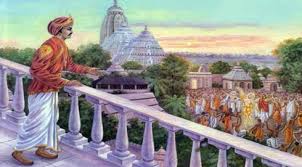
Despite several attempts, Prataparudra was denied an audience until he approached Chaitanya in disguise during the Rath Yatra festival. While the saint rested after devotional singing, Prataparudra gently massaged his feet and recited verses from the Bhagavata Purana. Chaitanya, overwhelmed with spiritual joy, embraced him, blessing him with divine grace.
This moment is considered a turning point in Bhakti literature, often symbolizing that devotion overrides worldly status.
Impact on Odisha
This relationship greatly influenced the cultural and religious landscape of Odisha:
- Vaishnavism became more widespread
- New devotional practices evolved
- Religious literature flourished
- The Jagannath Temple gained even greater prominence
Prataparudra’s devotion earned him the title Rajarsi (king-sage).
Patronage of Culture, Literature, and Temples
Like his predecessors, Prataparudra was a great patron of:
1. Literature
He supported Sanskrit and Odia scholars, leading to the creation of devotional poetry and theological works associated with Jagannath culture and Vaishnavism.
2. Temple Tradition
Prataparudra strengthened rituals and daily management at the Jagannath Temple in Puri. Many festivals and traditions practiced today were refined during his rule.
3. Art and Architecture
Under his patronage, temple art, wooden carvings, and classical dance (early forms of Odissi) flourished.
Administration and Governance
Despite spiritual inclinations, Prataparudra was a capable administrator. He:
- Reorganized provincial divisions
- Strengthened revenue collection
- Maintained coastal defenses
- Encouraged agricultural expansion
- Improved port trade in Odisha’s coastal regions
His policies ensured economic stability even as military challenges increased.
Decline of the Empire
During the later part of his reign, Odisha gradually lost many southern territories due to repeated invasions by Golconda and Vijayanagara. However, Prataparudra’s diplomacy and strategic retreats ensured that the core of the Gajapati Empire—Odisha proper—remained safe.
Known For:
- Devotee and disciple of Sri Chaitanya Mahaprabhu
- One of the most religious Gajapati rulers
- Military resistance against the Bengal Sultanate and Qutb Shahi kings
- Expansion and protection of Jagannath Temple traditions
- Cultural patronage (literature, music, temple arts)
Death and Legacy
Prataparudra Deva died around 1540 CE in Puri, leaving behind a rich legacy of spirituality, cultural revival, and temple tradition. His descendants continued to rule smaller parts of Odisha after the breakup of the larger empire.
Legacy Highlights
- One of Odisha’s most spiritual rulers
- Devotee and disciple of Sri Chaitanya
- Strengthened Jagannath culture
- Patron of Odia and Sanskrit literature
- Maintained Odisha’s sovereignty despite external threats
- Remembered for humility, devotion, and leadership
In the history of Odisha, Prataparudra Deva stands as a unique king who combined spiritual depth with administrative responsibility, and whose devotion shaped the religious identity of the region for centuries.
