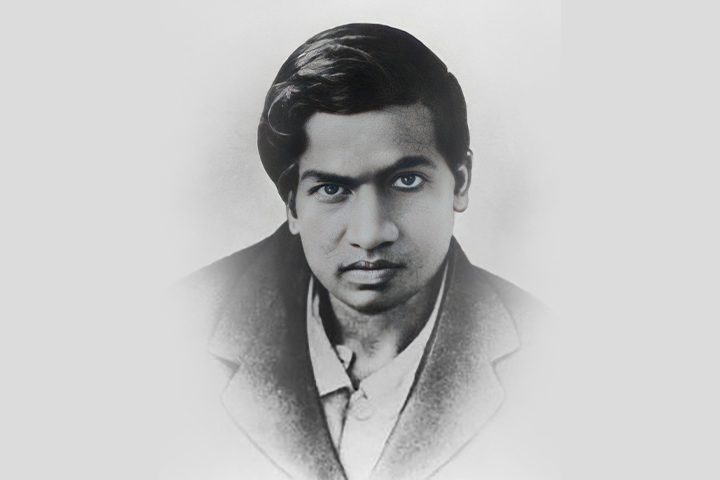
Personal Information
- Place of Birth: 22 December 1887, Erode, Tamil Nadu, India
- Place of Death: 26 April 1920 (age 32),
- Occupation: Mathematics
Summary
Biography
Early Life
Srinivasa Ramanujan was born into a modest Tamil Brahmin family in Erode, Tamil Nadu. His father, K. Srinivasa Iyengar, was a clerk, and his mother, Komalatammal, was deeply religious and encouraged his early interest in mathematics.
From a young age, Ramanujan displayed extraordinary mathematical abilities. By age 12, he had mastered trigonometry, and by 15, he was developing his own mathematical theorems. He studied on his own, often without guidance, and relied heavily on self-taught methods and recreational mathematics books, including G.S. Carr’s Synopsis of Elementary Results in Pure and Applied Mathematics.
Education
Ramanujan struggled in formal education due to his focus on mathematics over other subjects. He eventually earned a scholarship to study at Pachaiyappa’s College, but he failed in other subjects and had to leave formal schooling. Despite these challenges, he continued his mathematical research independently, working on series, continued fractions, and number theory.
Career and Achievements
- In 1913, Ramanujan sent a letter with 120 theorems to the British mathematician G.H. Hardy at Cambridge University. Hardy immediately recognized his genius and invited him to England.
- Ramanujan moved to Cambridge in 1914, where he collaborated with Hardy. Their partnership led to significant advancements in analytic number theory, partition functions, and modular forms.
- He independently developed Ramanujan’s tau function, Ramanujan primes, and mock theta functions, many of which remain influential in modern mathematics.
- Despite struggling with health issues due to the English climate and diet, he produced groundbreaking work in a very short period.
Mathematical Contributions
- Number Theory – Highly original formulas, including results on prime numbers, partitions, and sums of squares.
- Infinite Series – Discovered rapidly converging series for π and other constants.
- Continued Fractions – Developed remarkable formulas used in advanced analysis.
- Ramanujan’s Notebooks – Contained thousands of results, many without proofs, which continue to inspire mathematicians.
Honors
- Elected Fellow of the Royal Society (FRS) in 1918.
- Elected Fellow of Trinity College, Cambridge.
- His birthday, 22 December, is celebrated as National Mathematics Day in India.
Death
Ramanujan returned to India in 1919 due to ill health. He died on 26 April 1920 in Kumbakonam at the age of 32. Despite his short life, his contributions to mathematics were monumental.
Legacy
- Ramanujan’s work has inspired modern mathematics, particularly in number theory, combinatorics, and modular forms.
- His life story has been immortalized in books, films, and documentaries, emphasizing his genius and perseverance against adversity.
- The Ramanujan Institute of Mathematics in Chennai, India, is dedicated to his memory.