Vasudeva I
Warriors & Kings | c. 2nd Century CE (Exact date unknown) - c. 232 CE
"Vasudeva I was the last great emperor of the Kushan Empire who preserved its power, promoted trade and cultural integration, and strengthened Hindu influences within the imperial administration."
Born
c. 2nd Century CE (Exact date unknown)Birthplace
Kushan Empire (likely Mathura region or Bactria; exact location unknown)Died
c. 232 CEPlace of Death
Kushan Empire (Exact location unknown)Nationality
KushanGender
MaleVasudeva I Biography
Vasudeva I was one of the most significant rulers of the Kushan Dynasty and is widely regarded as the last great emperor of the Kushan Empire. He ruled during the late second and early third centuries CE, a period that marked both the continuation of Kushan prosperity and the beginning of new political challenges. As the successor of Huvishka, Vasudeva inherited a vast empire that stretched across important parts of northern India, Afghanistan, and Central Asia.
His reign occupies a special place in ancient Indian history because it represented the final phase of the Kushan Empire's golden age. Although he did not achieve the dramatic military conquests associated with Kanishka the Great, Vasudeva proved to be an effective ruler who maintained political stability, supported economic growth, and encouraged cultural development. His rule helped preserve Kushan authority during a time of changing political conditions across Asia.
Historical knowledge about Vasudeva I comes primarily from inscriptions, coins, archaeological discoveries, and foreign records. These sources reveal the image of a ruler who successfully managed a multicultural empire while adapting to new political realities.
Early Life and Background
The exact date and location of Vasudeva I's birth remain unknown. Like many ancient rulers, information regarding his childhood has not survived in detailed historical records. However, scholars agree that he was born into the royal Kushan family during a period when the empire was among the most powerful political entities in Asia.
Vasudeva belonged to a dynasty that had transformed from a Central Asian tribal confederation into the rulers of a vast multicultural empire. By the time of his birth, the Kushans governed territories inhabited by people of diverse ethnic, cultural, and religious backgrounds. This environment exposed him to a variety of traditions and likely influenced his approach to governance.
As a member of the royal household, Vasudeva would have received education in administration, military leadership, diplomacy, finance, and religious affairs. Such preparation was essential for governing an empire that controlled important trade routes and major urban centers.
Accession to the Throne
Vasudeva I succeeded Emperor Huvishka and became one of the final powerful rulers of the Kushan Dynasty. Inscriptions dating from his reign suggest that he ruled for several decades and exercised authority over extensive territories in northern India and Central Asia. Historical evidence indicates that he governed from important urban centers, particularly Mathura, which had become a major political and cultural center of the empire.
His accession occurred during a period when the Kushan Empire remained influential but faced increasing external pressures. Instead of pursuing large-scale territorial expansion, Vasudeva focused on maintaining stability and preserving the institutions inherited from earlier rulers.
This strategy proved effective and enabled the empire to remain prosperous throughout much of his reign.
The Kushan Empire Under Vasudeva I
The Kushan Empire under Vasudeva remained one of the major powers of Asia. The empire occupied a strategically important position connecting India, Central Asia, and regions further west. This location allowed the Kushans to control key commercial routes that linked multiple civilizations.
Major cities flourished under Kushan administration. These urban centers served as hubs of commerce, manufacturing, religion, and culture. Trade generated substantial wealth for merchants, artisans, and the royal treasury.
Although some frontier regions may have faced challenges from rising foreign powers, the core territories of the empire remained stable. Archaeological evidence demonstrates continued economic vitality and administrative effectiveness throughout Vasudeva's reign.
Administration and Governance
One of Vasudeva's most important contributions was his ability to preserve an effective administrative system. The Kushan Empire encompassed numerous provinces with different languages, customs, and religious traditions. Managing such diversity required practical leadership and efficient institutions.
Provincial governors were responsible for local administration, tax collection, public order, and infrastructure maintenance. These officials operated under imperial authority while allowing local communities to retain many traditional practices.
The administration facilitated communication between different parts of the empire and ensured that trade routes remained secure. Such measures encouraged economic development and political stability.
The longevity of Vasudeva's reign suggests that his government succeeded in maintaining internal cohesion despite the challenges faced by large empires during this period.
Economic Prosperity and Trade
Trade was one of the foundations of Kushan power, and Vasudeva continued policies that supported commercial growth. The empire controlled sections of the Silk Road, the vast network of routes connecting East Asia, Central Asia, India, and the Mediterranean world.
Merchants transported valuable commodities including silk, spices, textiles, precious stones, ivory products, metals, and luxury goods. Trade benefited both local communities and the imperial treasury through revenue generated from customs duties and taxes.
Commercial activity encouraged urban expansion and created opportunities for artisans, craftsmen, and merchants. Major cities became centers of cultural exchange where people from different regions interacted and exchanged ideas.
The prosperity of the Kushan Empire during Vasudeva's reign demonstrates the importance of international trade in sustaining ancient states.
Coinage and Monetary System
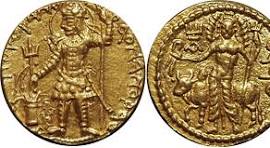
Vasudeva I is particularly well known through his coinage, which provides valuable insights into his reign. Large numbers of gold and copper coins bearing his name have been discovered by archaeologists across India, Afghanistan, and neighboring regions.
His coins reveal important developments in Kushan culture. Earlier Kushan rulers featured a wide variety of deities representing different religious traditions. During Vasudeva's reign, images associated with Shiva became especially prominent on the coinage, indicating stronger Indian religious influences within the royal court.
These coins also demonstrate the economic strength of the empire. Standardized currency facilitated trade throughout the kingdom and promoted commercial integration across vast distances.
Today, Vasudeva's coinage remains one of the most important sources for understanding Kushan history and culture.
Religious Policies and Cultural Identity
The reign of Vasudeva I represents an important stage in the cultural evolution of the Kushan Empire. Historians frequently note that his rule reflects increasing Indian influence within Kushan political and religious life.
Even his name, Vasudeva, has strong associations with Indian religious traditions. This distinguishes him from many earlier Kushan rulers whose names reflected Central Asian origins. His reign therefore illustrates the gradual integration of Kushan rulers into the cultural environment of the Indian subcontinent.
Although Shiva appears prominently on his coinage, there is also evidence that the empire remained religiously diverse. Buddhism continued to flourish in many regions under Kushan control, while other religious traditions maintained their presence throughout the empire.
This atmosphere of tolerance and coexistence contributed to social stability and cultural creativity.
Art, Architecture, and Society
The cultural achievements of the Kushan Empire continued during Vasudeva's reign. Artistic traditions associated with Mathura and Gandhara remained active and influential. Sculptors produced religious images, architectural decorations, and monuments that blended local and foreign influences.
Mathura, in particular, emerged as a major center of artistic production. The city attracted merchants, pilgrims, scholars, and craftsmen from various regions. Religious institutions received patronage from rulers, wealthy donors, and commercial communities.
The spread of artistic styles during this period demonstrates how interconnected the ancient world had become under the influence of trade and cultural exchange.
Foreign Relations and External Challenges
While Vasudeva enjoyed considerable success, his reign also witnessed the emergence of new political challenges. Powerful states were rising in neighboring regions, including the Sasanian Empire in Persia. These developments created pressure on the western frontiers of Kushan territory.
Despite these difficulties, Vasudeva succeeded in maintaining imperial authority for many years. His leadership delayed the fragmentation that would affect the Kushan Empire after his death.
Foreign contacts remained important. Historical sources indicate continued diplomatic and commercial interactions with neighboring civilizations, including regions of Central Asia and China. These connections helped preserve the international significance of the Kushan state.
Legacy and Historical Importance
Vasudeva I is remembered as the last great ruler of the Kushan Empire. His reign represents the culmination of centuries of political development that transformed the Kushans into one of the most influential powers of ancient Asia.
Although the empire eventually declined following his rule, Vasudeva's achievements helped preserve stability and prosperity during a critical transitional period. His administration maintained effective government, supported economic activity, and encouraged cultural integration throughout the empire.
The growing Indian influence visible during his reign also contributed to the long-term cultural evolution of northern India and neighboring regions. His coinage, inscriptions, and archaeological remains continue to provide valuable evidence for historians studying ancient Indian and Central Asian history.
Many scholars view Vasudeva as a ruler who successfully balanced continuity and adaptation. He preserved the traditions of earlier Kushan emperors while responding to the changing realities of his time.
Conclusion
Vasudeva I was one of the most capable rulers of the Kushan Dynasty and the final emperor generally regarded as belonging to the empire's great age. Through wise administration, support for trade, cultural patronage, and political stability, he ensured that the Kushan Empire remained a major force in Asia during the early third century CE.
His reign marked both the height of Kushan cultural integration and the closing chapter of one of the most remarkable empires in ancient history. Today, Vasudeva I is remembered as a significant monarch whose leadership helped shape the historical development of northern India, Central Asia, and the broader Silk Road world.
Comments & Tribute (0)