Samudragupta
Warriors & Kings | c. 335 CE (Approximate) - c. 380 CE (Approximate)
"Samudragupta was the greatest ruler of the Gupta Empire, renowned for his military conquests, political leadership, and cultural achievements that laid the foundation for India's Golden Age."
Born
c. 335 CE (Approximate)Birthplace
Gupta Empire, Ancient India (likely Magadha region, present-day Bihar)Died
c. 380 CE (Approximate)Place of Death
Gupta Empire, Ancient IndiaNationality
IndianGender
MaleSamudragupta Biography
Samudragupta was one of the greatest rulers in the history of ancient India and is widely regarded as the most powerful emperor of the Gupta Dynasty. His reign marked a crucial stage in the rise of the Gupta Empire, transforming it into one of the strongest and most influential kingdoms of ancient India. Historians frequently describe him as the "Napoleon of India" because of his remarkable military achievements, successful campaigns, and ability to establish political dominance over a vast region.
Beyond his military victories, Samudragupta was also a skilled administrator, diplomat, scholar, and patron of the arts. His reign laid the foundations for the period often referred to as the Golden Age of India, characterized by advances in literature, science, art, culture, and economic prosperity. Through a combination of military strength and political wisdom, he created an empire that became a model of effective governance and cultural excellence.
Early Life and Family Background
Samudragupta was born into the illustrious Gupta Dynasty during the fourth century CE. He was the son of Chandragupta I, the founder of the Gupta Empire's imperial power, and Queen Kumaradevi, a princess of the influential Licchavi clan. The alliance between the Gupta family and the Licchavis strengthened the political position of the dynasty and provided a solid foundation for future expansion.
Raised in an atmosphere of royal privilege and responsibility, Samudragupta received a comprehensive education suitable for a future emperor. He was trained in warfare, administration, diplomacy, literature, and religious traditions. Historical evidence suggests that he possessed exceptional intelligence, leadership qualities, and military skill from an early age.
His father recognized these abilities and selected him as his successor, even though there may have been rival claimants within the royal family. This decision proved significant, as Samudragupta would become one of India's most celebrated rulers.
Accession to the Throne
Following the reign of Chandragupta I, Samudragupta ascended the Gupta throne around the middle of the fourth century CE. His accession marked the beginning of an era of expansion and consolidation for the Gupta Empire.
In the early years of his reign, he focused on strengthening his authority and establishing firm control over the territories inherited from his father. Once internal stability was secured, he began a series of military campaigns that would dramatically increase the size and influence of the Gupta state.
His reign represented a turning point in Indian history because it transformed the Guptas from a regional power into a dominant imperial force.
Military Campaigns and Conquests
Samudragupta is best remembered for his extraordinary military achievements. The primary source of information about his conquests is the famous Prayag Prashasti, an inscription composed by his court poet Harisena. This inscription provides a detailed account of his victories and achievements.
The emperor launched campaigns across northern, central, and southern India. He defeated numerous kings and incorporated their territories into his empire or established them as tributary states. His victories demonstrated both military excellence and strategic brilliance.
In northern India, Samudragupta successfully expanded Gupta authority over neighboring kingdoms and integrated many territories directly into the empire. These conquests increased political stability and strengthened imperial administration.
His southern expedition was particularly significant. Rather than annexing all conquered territories, he often allowed defeated rulers to continue governing their kingdoms in exchange for allegiance and tribute. This policy enabled him to extend Gupta influence without overextending administrative resources.
The combination of force and diplomacy contributed greatly to his success and distinguished him from many contemporaries.
The Title "Napoleon of India"
Modern historians have frequently compared Samudragupta to Napoleon Bonaparte because of his remarkable record of military victories. While the comparison is not exact, it reflects the extraordinary scale of his achievements on the battlefield.
His campaigns covered vast geographical regions and involved numerous kingdoms. Few rulers in ancient Indian history achieved such extensive military success within a relatively short period.
Unlike many conquerors, however, Samudragupta also demonstrated considerable diplomatic flexibility. Instead of relying solely on military occupation, he used alliances, tribute arrangements, and political partnerships to maintain influence over distant territories.
This balanced approach helped create a stable imperial structure capable of enduring beyond his lifetime.
Administration and Governance
Military success alone could not have sustained a large empire. Samudragupta was also an effective administrator who developed systems capable of governing extensive territories. His administration emphasized efficiency, law and order, and cooperation with local authorities.
Provincial governors managed regional affairs while remaining accountable to the imperial government. This administrative structure enabled the emperor to maintain control over diverse populations spread across large distances.
The empire benefited from improved communication, taxation systems, and public administration. These measures generated revenue that supported military activities, infrastructure, and cultural patronage.
The stability achieved under Samudragupta created favorable conditions for economic development and social progress.
Economic Prosperity
The Gupta Empire experienced considerable economic growth during Samudragupta's reign. Agriculture remained the foundation of the economy, supported by fertile river valleys and favorable climatic conditions.
Trade also played an important role. Commercial routes connected different regions of the empire and facilitated the movement of goods, people, and ideas. Merchants traded textiles, agricultural products, metals, precious stones, and luxury items both within India and with foreign regions.
Economic prosperity contributed to urban development and increased royal revenues. Growing wealth allowed the state to support scholars, artists, religious institutions, and public works.
The prosperity achieved during this period helped establish the conditions that later generations would identify as the Golden Age of India.
Religious Policy and Tolerance
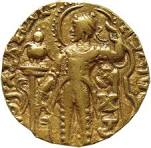
Samudragupta was a follower of Hindu traditions and performed important Vedic rituals, including the Ashvamedha sacrifice, which symbolized imperial sovereignty and power. Coins issued during his reign commemorate this significant ceremony.
Despite his commitment to Hinduism, he demonstrated tolerance toward other religious communities. Buddhism, Jainism, and various local traditions continued to flourish within the Gupta Empire.
His inclusive approach promoted social harmony and reduced religious conflict across the empire. This atmosphere of tolerance contributed to the cultural vitality of the period.
Patron of Arts and Culture
In addition to being a warrior and statesman, Samudragupta was also a patron of learning and culture. Historical evidence suggests that he appreciated literature, music, and scholarly pursuits.
Some coins depict him playing a musical instrument known as the veena. These images reveal an aspect of his personality that differs from the traditional image of a military conqueror. They suggest that he valued artistic expression and intellectual achievement.
The cultural environment fostered during his reign encouraged the growth of literature, philosophy, and the arts. Scholars and artists benefited from court patronage and contributed to the cultural achievements of the Gupta era.
This support for cultural development became one of the defining characteristics of Gupta civilization.
Foreign Relations and Diplomacy
Samudragupta maintained diplomatic relations with neighboring kingdoms and distant regions. Several rulers chose to acknowledge his supremacy through tribute and formal recognition rather than engage in conflict.
The emperor's reputation extended beyond the borders of the Gupta Empire. Foreign rulers recognized his power and sought friendly relations with his court. Such interactions promoted trade, cultural exchange, and political stability.
Diplomacy played an important role in maintaining the empire's influence across South Asia and surrounding regions.
The Prayag Prashasti
One of the most valuable historical sources for understanding Samudragupta's life is the Prayag Prashasti inscription. Composed by Harisena, a court poet and official, the inscription records the emperor's achievements, military victories, and personal qualities.
The inscription portrays him as a courageous warrior, wise ruler, generous patron, and protector of dharma. Although it naturally emphasizes his successes, it remains an indispensable source for reconstructing the history of the Gupta Empire.
The Prayag Prashasti demonstrates the importance of inscriptions in preserving the memory of ancient rulers and provides detailed evidence about political developments during Samudragupta's reign.
Legacy and Historical Importance
Samudragupta occupies a central position in Indian history because he transformed the Gupta Empire into a powerful imperial state. His military conquests expanded the empire, while his administrative policies ensured its stability and prosperity.
Many historians consider his reign the foundation of the Gupta Golden Age, a period renowned for achievements in science, mathematics, literature, philosophy, art, and governance. His success created conditions that enabled later Gupta rulers to continue advancing Indian civilization.
His example as a warrior, statesman, diplomat, and patron of culture made him one of the most admired kings of ancient India. The influence of his reign extended long beyond his lifetime and shaped the historical development of the Indian subcontinent.
Conclusion
Samudragupta was among the greatest emperors of ancient India. His military brilliance earned him widespread recognition, while his administrative skill, cultural patronage, and religious tolerance ensured the long-term success of the Gupta Empire.
Through his leadership, the Gupta state became a dominant force in South Asia and laid the groundwork for one of the most celebrated periods in Indian history. Today, Samudragupta remains a symbol of imperial achievement, visionary leadership, and cultural excellence. His legacy continues to be admired by historians and students of Indian history around the world.
Comments & Tribute (0)