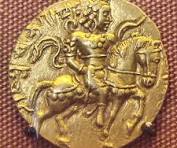
Chandragupta II Vikramaditya
Warriors & Kings | c. 375 CE (Approximate) - c. 415 CE (Approximate)
"Chandragupta II, famously known as Vikramaditya, was one of the greatest Gupta emperors who expanded the empire, promoted culture and learning, and ushered in a golden age of prosperity in ancient India."
Born
c. 375 CE (Approximate)Birthplace
Gupta Empire, Ancient India (likely Pataliputra or Ujjain region)Died
c. 415 CE (Approximate)Place of Death
Gupta Empire, Ancient IndiaNationality
IndianGender
MaleChandragupta II (Vikramaditya) Biography
Chandragupta II, popularly known as Vikramaditya, was one of the greatest emperors of ancient India and one of the most celebrated rulers of the Gupta Dynasty. His reign marked the height of the Gupta Empire's power, prosperity, and cultural achievement. Historians widely regard his rule as a defining period of India's Golden Age, characterized by remarkable advancements in art, literature, science, trade, education, and administration.
As the son of the renowned emperor Samudragupta, Chandragupta II inherited a strong and expanding empire. Through military campaigns, strategic alliances, and effective governance, he transformed the Gupta Empire into one of the most powerful states in Asia. His victory over the Western Kshatrapas brought immense wealth and control over important trade routes, contributing significantly to the empire's prosperity.
Beyond military success, Chandragupta II is remembered as a patron of scholars, artists, and intellectuals. His association with the legendary title "Vikramaditya" symbolizes wisdom, courage, justice, and cultural excellence.
Early Life and Family Background
Chandragupta II was born into the distinguished Gupta royal family during the fourth century CE. He was the son of Emperor Samudragupta, one of India's greatest conquerors, and Queen Dattadevi. Growing up in the royal court, he received an education that emphasized military training, governance, literature, philosophy, and religious traditions.
The Gupta royal family was known for encouraging intellectual pursuits alongside military excellence. As a prince, Chandragupta observed firsthand how his father expanded and administered a vast empire. These experiences played a key role in shaping his leadership abilities and preparing him for future responsibilities.
The political environment in which he grew up was one of stability and expansion. The Gupta Empire had already emerged as a major force in northern India, giving Chandragupta a strong foundation upon which to build.
Accession to the Throne
Following the reign of Samudragupta, Chandragupta II succeeded to the throne around 380 CE. Historical traditions suggest that his accession may have involved political challenges, but ultimately he emerged as the undisputed ruler of the Gupta Empire.
Upon becoming emperor, Chandragupta inherited a vast territory stretching across much of northern India. However, he was not satisfied with merely preserving his father's achievements. Instead, he sought to strengthen and expand the empire further.
His reign would eventually become one of the most successful and influential periods in Indian history.
Expansion of the Gupta Empire
One of Chandragupta II's most significant achievements was the territorial expansion of the Gupta Empire. He pursued a policy of military strength combined with diplomatic alliances. Strategic marriages and political relationships helped secure alliances with neighboring rulers and reduced potential threats.
The most famous military achievement of his reign was the defeat of the Western Kshatrapas. These rulers controlled important territories in western India, including regions that were vital for trade and economic activity.
After a series of successful campaigns, Chandragupta II defeated the Western Kshatrapas and incorporated their territories into the Gupta Empire. This victory enabled the empire to gain access to important ports along the Arabian Sea and strengthen commercial links with foreign markets.
The conquest significantly enhanced the political prestige and economic resources of the Gupta state.
Defeat of the Western Kshatrapas
The defeat of the Western Kshatrapas stands among Chandragupta II's greatest accomplishments. These rulers had maintained control over western India for centuries and represented a significant obstacle to Gupta expansion.
Through careful planning and military leadership, Chandragupta succeeded in overthrowing their authority. The acquisition of Gujarat, Malwa, and neighboring regions brought substantial benefits to the empire.
These newly acquired territories gave the Gupta Empire increased access to maritime trade and enhanced its economic prosperity. The victory also strengthened Chandragupta's reputation as one of the most capable military rulers of his era.
Administration and Governance
Chandragupta II was not only a conqueror but also an exceptional administrator. He maintained a well-organized government capable of managing diverse territories spread across a large geographical area.
Provincial governors administered local regions while remaining accountable to the imperial administration. This decentralized approach allowed efficient governance while preserving local traditions and customs.
Justice, law and order, and public welfare received considerable attention during his rule. The stability created by effective governance encouraged agricultural production, trade, and urban development.
The emperor's administration helped establish conditions that allowed the Gupta Empire to flourish economically and culturally.
Economic Prosperity
The Gupta Empire experienced remarkable economic growth under Chandragupta II. Agriculture remained the foundation of the economy, but trade increasingly contributed to prosperity.
Control of western coastal regions allowed merchants to expand overseas trade with the Roman world, Persia, Arabia, and Southeast Asia. Goods such as textiles, spices, ivory, precious stones, and metal products were exchanged through thriving commercial networks.
Trade generated substantial wealth for both merchants and the royal treasury. This prosperity supported public works, religious institutions, and cultural activities throughout the empire.
The flourishing economy became one of the defining features of the Gupta Golden Age.
The Golden Age of India
Historians often describe Chandragupta II's reign as part of the Golden Age of India. During this period, remarkable achievements occurred in literature, science, mathematics, astronomy, philosophy, medicine, and the arts.
Intellectual activity flourished in major educational and cultural centers. Scholars produced important works that influenced Indian civilization for centuries. The stable political environment created by Chandragupta's administration provided ideal conditions for learning and creativity.
This era witnessed advances that continue to be celebrated as significant contributions to world civilization.
Patron of Arts and Literature
Chandragupta II became famous as a patron of literature and the arts. According to traditional accounts, his court included the "Navaratnas" or Nine Gems, a group of distinguished scholars, poets, and intellectuals.
Among the most celebrated figures associated with his court was Kalidasa, who is widely regarded as one of the greatest poets and dramatists in Sanskrit literature. Although some historical details remain debated, the association reflects the emperor's reputation for supporting intellectual and artistic excellence.
His patronage encouraged the creation of literary masterpieces that enriched Indian culture and influenced later generations.
Religious Policy and Tolerance
Chandragupta II followed Hindu traditions and supported religious institutions throughout the empire. Temples received patronage, and religious ceremonies formed an important part of royal life.
Despite his personal beliefs, he maintained a policy of religious tolerance. Buddhists, Jains, and followers of various traditions coexisted peacefully within the Gupta Empire.
This atmosphere of tolerance helped promote social harmony and contributed to the stability of the state. Religious diversity became one of the strengths of Gupta society.
Accounts of Fa-Hien
One of the most valuable sources for understanding conditions during Chandragupta II's reign comes from the Chinese Buddhist traveler Fa-Hien. He visited India during this period and recorded his observations.
Fa-Hien described a prosperous society characterized by peace, efficient administration, and economic well-being. His writings indicate that people generally enjoyed security and that trade and religious life flourished.
These accounts provide important independent evidence regarding the success of Chandragupta's administration.
Ujjain as a Cultural Center
Under Chandragupta II, Ujjain emerged as an important political and cultural center. Located along major trade routes, the city became a hub of commerce, education, and artistic activity.
Its strategic location enhanced communication between different regions of the empire and promoted cultural exchange. Ujjain's prominence reflected the broader prosperity and stability that characterized Chandragupta's reign.
The city would remain an influential center of Indian civilization for centuries.
Legacy and Historical Importance
Chandragupta II is remembered as one of the greatest monarchs in Indian history. His conquest of the Western Kshatrapas expanded the Gupta Empire and strengthened its economic foundations. His support for scholars and artists contributed significantly to the cultural achievements of the Golden Age.
The prosperity, stability, and intellectual vitality of his reign established standards that later rulers would seek to emulate. His leadership demonstrated how military strength, effective governance, and cultural patronage could combine to create a flourishing civilization.
The title Vikramaditya became associated with ideal kingship and continued to inspire legends and traditions long after his death.
Conclusion
Chandragupta II Vikramaditya was a visionary ruler whose reign represents one of the finest chapters in ancient Indian history. Through military victories, administrative competence, economic development, and cultural support, he elevated the Gupta Empire to unprecedented heights.
His achievements helped shape the Golden Age of India and contributed to the growth of a civilization renowned for its advances in knowledge, art, and governance. Today, Chandragupta II remains a symbol of enlightened leadership, imperial success, and cultural excellence whose legacy continues to be celebrated throughout India and the world.
Comments & Tribute (0)