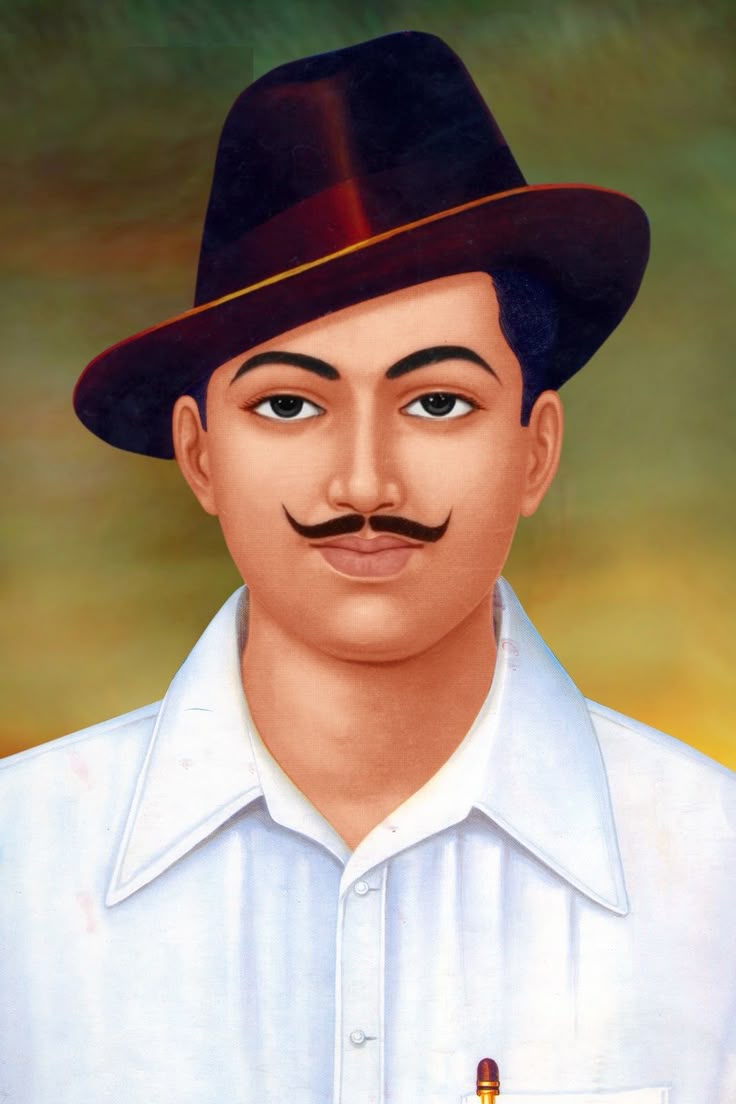
Bhagat Singh
Freedom Fighters | 28 September 1907 - 23 March 1931
"Bhagat Singh was one of India's most celebrated revolutionary freedom fighters who dedicated his life to ending British colonial rule. Known for his courage, patriotism, and sacrifice, he became a symbol of youth resistance after his execution at the age of 23."
Born
28 September 1907Birthplace
Banga Village, Lyallpur District, Punjab, British India (Present-day Faisalabad, Pakistan)Died
23 March 1931Place of Death
Lahore Central Jail, Lahore, Punjab, British India (Present-day Pakistan)Nationality
IndianGender
MaleBhagat Singh Biography
Bhagat Singh was one of the most influential revolutionary freedom fighters in Indian history. His courage, patriotism, and willingness to sacrifice his life for the nation made him a symbol of resistance against British colonial rule. Despite his young age, he inspired millions of Indians with his revolutionary ideas and unwavering commitment to India's independence.
Early Life and Family
Bhagat Singh was born on 28 September 1907 in Banga village of Lyallpur district, Punjab, British India. He was born into a patriotic Sikh family deeply involved in the freedom movement. His father, Kishan Singh, and uncle, Ajit Singh, were active participants in anti-British activities.
Growing up in such an environment, Bhagat Singh developed a strong sense of nationalism from an early age. Stories of Indian heroes and freedom fighters inspired him to dedicate his life to the country's independence.
Education and Influences
Bhagat Singh received his early education in Punjab and later joined the National College in Lahore, founded by Lala Lajpat Rai. During his student years, he studied the works of revolutionary leaders from India and around the world.
The Jallianwala Bagh Massacre of 1919 had a profound impact on him. The brutal killing of innocent Indians by British forces strengthened his determination to fight against colonial oppression.
Entry into the Revolutionary Movement
As a young man, Bhagat Singh joined several revolutionary organizations dedicated to ending British rule. He later became an active member of the Hindustan Socialist Republican Association (HSRA), which aimed to achieve independence through revolutionary action.
He believed that freedom could not be achieved without challenging the injustices of the colonial government. His intelligence, leadership qualities, and dedication quickly made him a prominent revolutionary figure.
Protest Against the Simon Commission
In 1928, the British government sent the Simon Commission to India. Since no Indian members were included in the commission, widespread protests erupted across the country.
During one such protest in Lahore, police brutally lathi-charged demonstrators, causing severe injuries to Lala Lajpat Rai. Rai later died due to these injuries. Bhagat Singh and his associates vowed to avenge his death.
Assassination of Saunders
In December 1928, Bhagat Singh, Rajguru, and Sukhdev planned to target the police officer responsible for the lathi charge. However, due to mistaken identity, Assistant Superintendent of Police John Saunders was shot instead.
The incident made Bhagat Singh one of the most wanted revolutionaries in British India.
Central Legislative Assembly Bombing
On 8 April 1929, Bhagat Singh and Batukeshwar Dutt threw non-lethal bombs into the Central Legislative Assembly in Delhi. Their intention was not to cause casualties but to protest against repressive laws imposed by the British government.
After throwing the bombs, they shouted revolutionary slogans such as "Inquilab Zindabad" (Long Live the Revolution) and deliberately surrendered to spread their message to the nation.
Imprisonment and Hunger Strike
While in prison, Bhagat Singh demanded equal treatment for Indian political prisoners. He led a historic hunger strike against discrimination and poor prison conditions.
The hunger strike attracted national attention and earned him widespread public support. His determination and resilience made him a hero among the youth of India.
Lahore Conspiracy Case
British authorities charged Bhagat Singh, Rajguru, and Sukhdev in the Lahore Conspiracy Case for their revolutionary activities and involvement in Saunders' assassination.
Despite facing severe punishment, Bhagat Singh remained fearless and used the trial as a platform to promote the ideals of freedom, equality, and justice.
Martyrdom
On 23 March 1931, Bhagat Singh, Rajguru, and Sukhdev were executed by hanging in Lahore Central Jail. Bhagat Singh was only 23 years old at the time of his death.
His execution sparked outrage across India and transformed him into a national martyr. Millions mourned his death and celebrated his sacrifice for the nation.
Political Ideology
Bhagat Singh believed in secularism, social equality, and justice. He advocated for a society free from exploitation and discrimination. Through his writings and speeches, he encouraged young people to think critically and work for social change.
His famous essay, "Why I Am an Atheist", reflects his intellectual depth and independent thinking.
Legacy
Bhagat Singh remains one of India's greatest national heroes. His life symbolizes courage, sacrifice, and unwavering patriotism. Every year, millions of Indians pay tribute to him on Shaheed Diwas, observed on 23 March.
Numerous educational institutions, roads, parks, and public memorials have been named in his honor. His revolutionary spirit continues to inspire generations of Indians.
Honours and Recognition
- Widely known as "Shaheed Bhagat Singh" for his supreme sacrifice.
- Recognized as one of the most influential revolutionaries of India's freedom struggle.
- His slogan "Inquilab Zindabad" became a powerful rallying cry for independence.
- Remembered annually on Shaheed Diwas along with Rajguru and Sukhdev.
Conclusion
Bhagat Singh dedicated his life to the cause of Indian independence and social justice. His bravery, sacrifice, and revolutionary ideals made him an enduring symbol of patriotism. Even decades after his martyrdom, his legacy continues to inspire people to stand against injustice and work toward a better society.
Comments & Tribute (1)